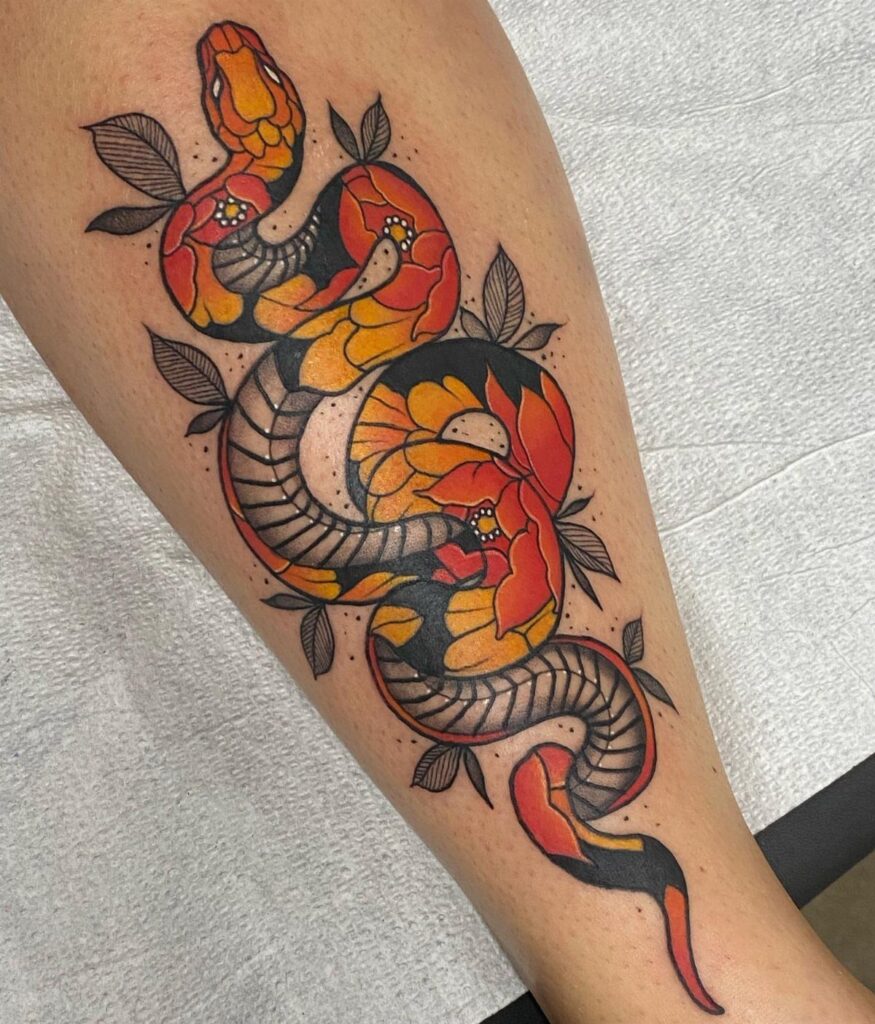
Traditional snake shin tattoos range from a single black-and-grey session on one leg to a years-long two-leg commitment, and the deciding factor is how much of your lower body you want treated as one continuous piece.
A coiled piece keeps the work on one leg and lets you test the bone-heavy pain of the shin without crossing the knee joint, while the full two-leg wrap demands color matching across separate sessions and healed touch-ups before the second leg even starts.
[link-whisper-related-posts]1. Traditional Coiled Snake Shin Tattoo
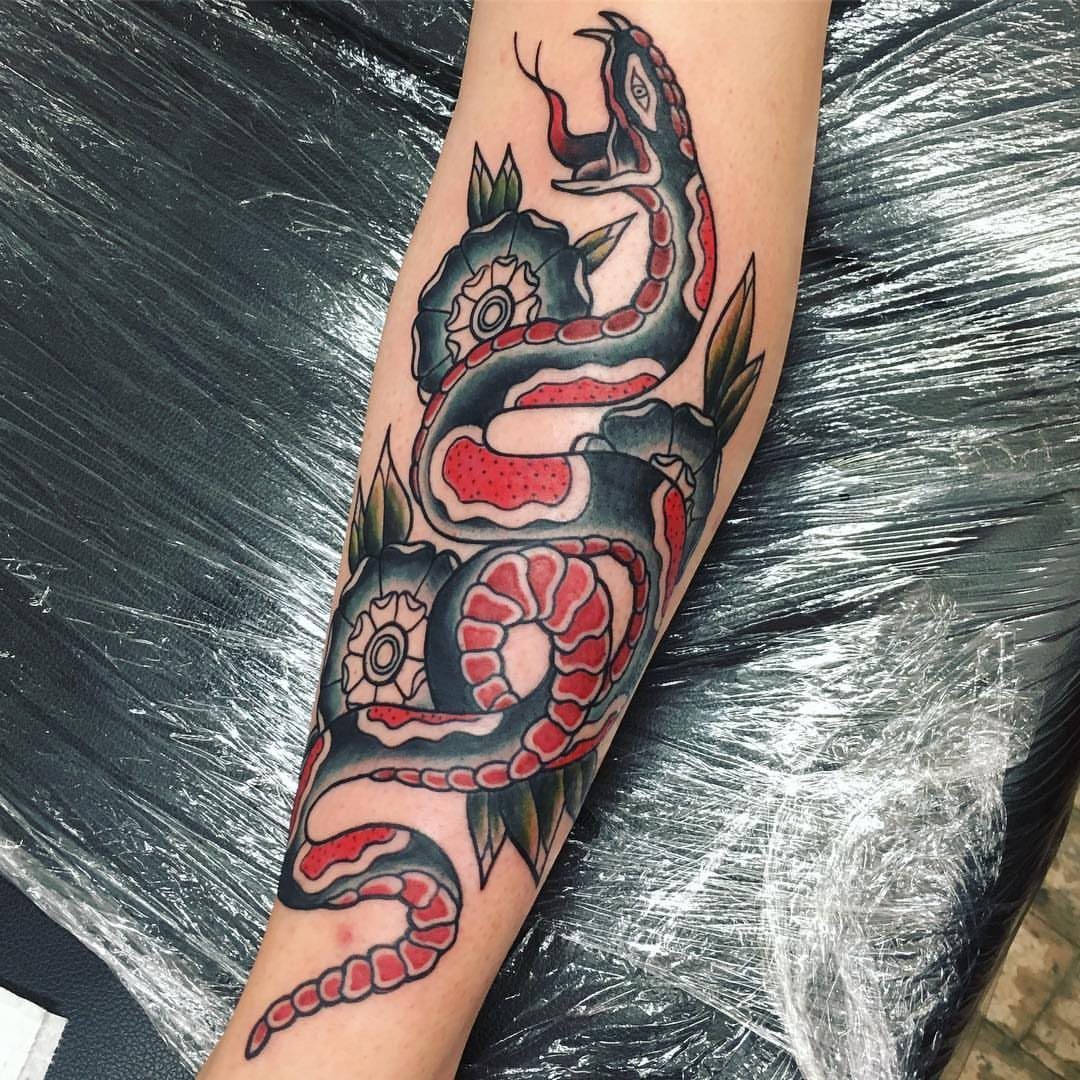
A coiled snake on the shin reads as ready to strike, the curve of the leg giving the coil natural tension.
The traditional build uses thick black outlines and heavy saturation; on the shin that contrast holds up against sun and sock friction better than finer work.
Patterned scales in black ink with stippled shading on the flanking flowers keep the old-school feel without crowding the bone.
I would ask the artist to place the tightest part of the coil just off-center of the shinbone itself; the flat of the muscle carries the detail better and hurts less than riding the ridge dead center.

Eye-Catching Design: Enhance your Halloween look with our Gold Snake Scales Tattoo Stickers, specifically designed to add an exotic and unique flair to any costume, ensuring you stand out at parties and events

Gorgeous Glimmering Festival DIY Face Jewels: 2 sets handcrafted rhinestone face eye nail body gems tattoo stickers that complete your festival outfit with these amazing gems and use these crystal holographic face jewels along with glitter to accent your beautiful makeup

2. Bold Statement Shin Tattoo
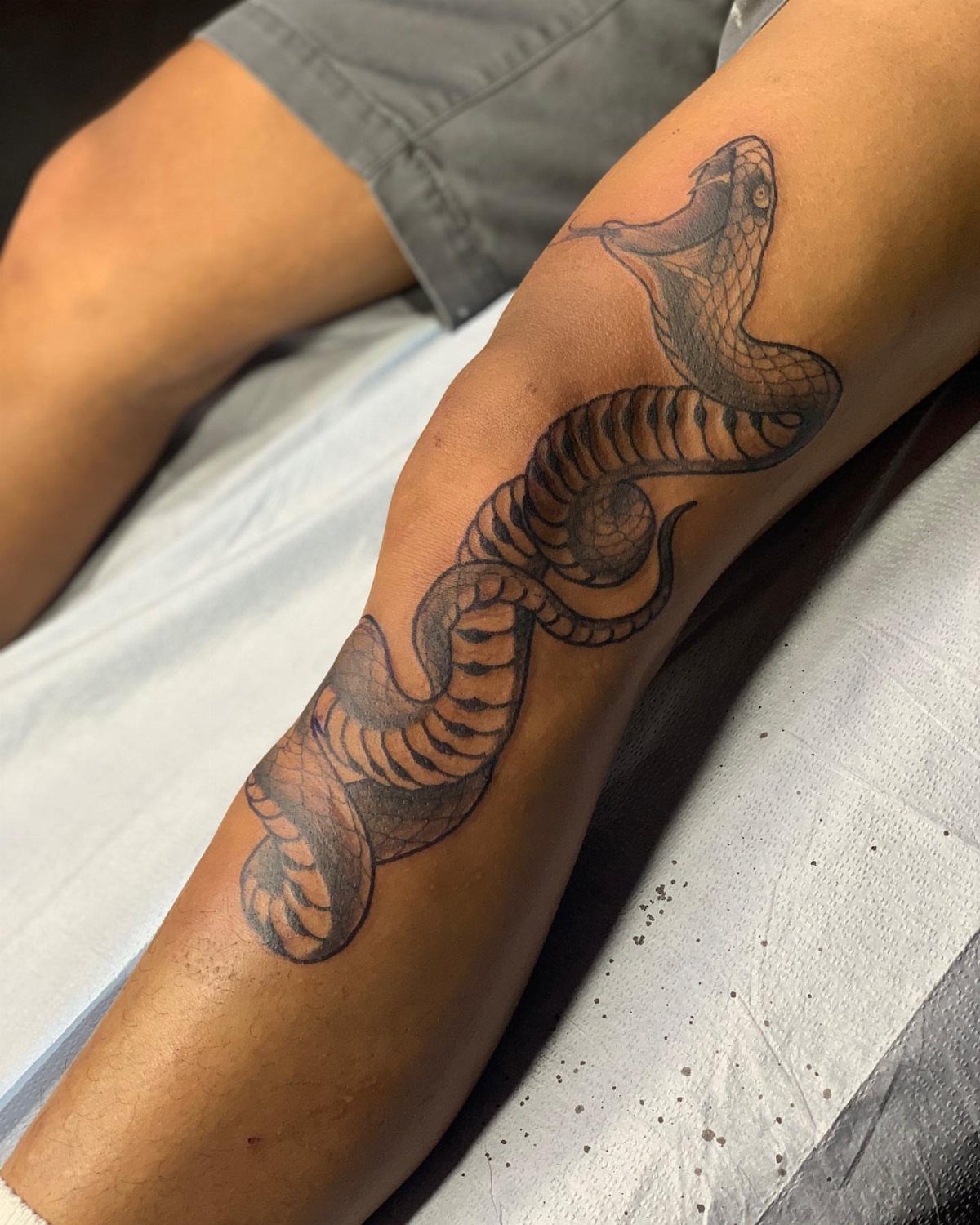
A snake that starts above the knee and winds across the joint onto the shin makes the whole leg the canvas.
The knee crossing is the hard part: skin there stretches and shifts more than most spots, so the line work needs to be bold enough to stay legible when you stand straight.
Black and grey keeps the focus on the form rather than the color, which helps when the design has to read from multiple angles.
This is the choice if you want the piece visible in shorts but still covered for work; the tradeoff is longer sessions and more healing attention around the bend.

Package:You will get 4 Sheets snake tattoo stickers for Halloween medusa cosplay costume
Durable Reusable Stencil Set: Includes multiple snake and alligator skin pattern templates made from high-quality, flexible stencil material for repeated use without tearing or warping.

Delicate design: You will receive 11pcs mermaid scale stencils, include big large 8pcs 6x8 inch mermaid stencils, small mimi 7x3.75 inch, 5.5x2.9 inch and 4.7x3.1 inch face body paint stencils and a organize storage ring, different sizes of fish scales for your daily need,make your face and art projects more attractive.
3. Traditional Snake Tattoo with Limited Colors
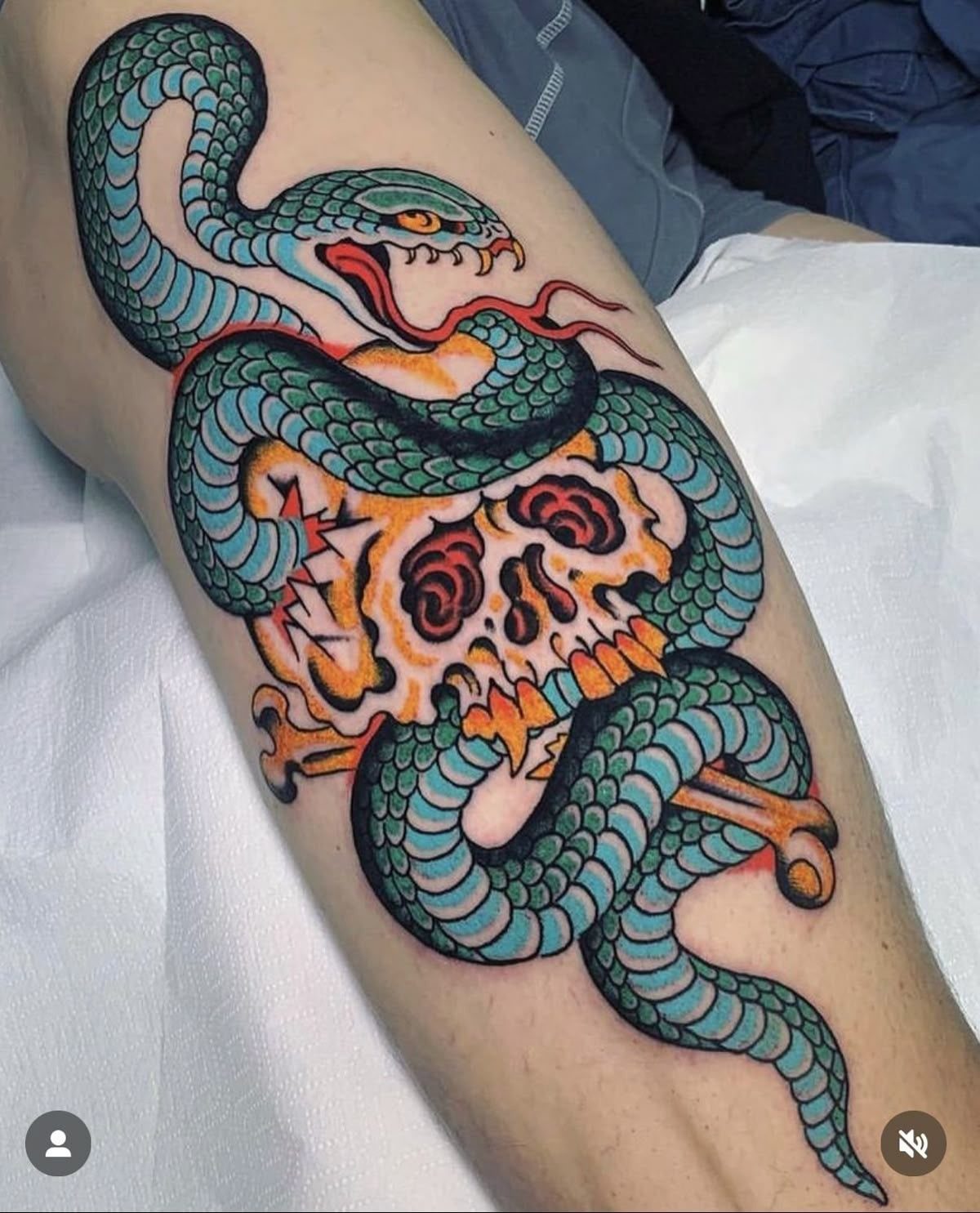
Turquoise against black line work is less common than red on the shin, so it stands out in a lineup of traditional pieces without breaking the rules.
If you are drawn to color but worry about commitment, this approach limits your palette to pigments that age well; yellows can fade faster, so the skull placement on the outer calf, less sun-exposed than the front, is a smart move.

MADE IN THE USA SINCE 1990: For over 30 years Dynamic Color has produced professional tattoo ink in the United States, an established American brand artists built their work on long before most imported labels existed.

MADE IN THE USA SINCE 1990: For over 30 years Dynamic Color has produced professional tattoo ink in the United States, an established American brand artists built their work on long before most imported labels existed.

Professional Tattoo Ink - Many of the most popular tattoo artists around the globe turn to World Famous' bold, beautiful tattoo ink, tattoo supplies & tattoo kits to deliver a flawless work of art.
4. Traditional Snake and Floral Shin Tattoo
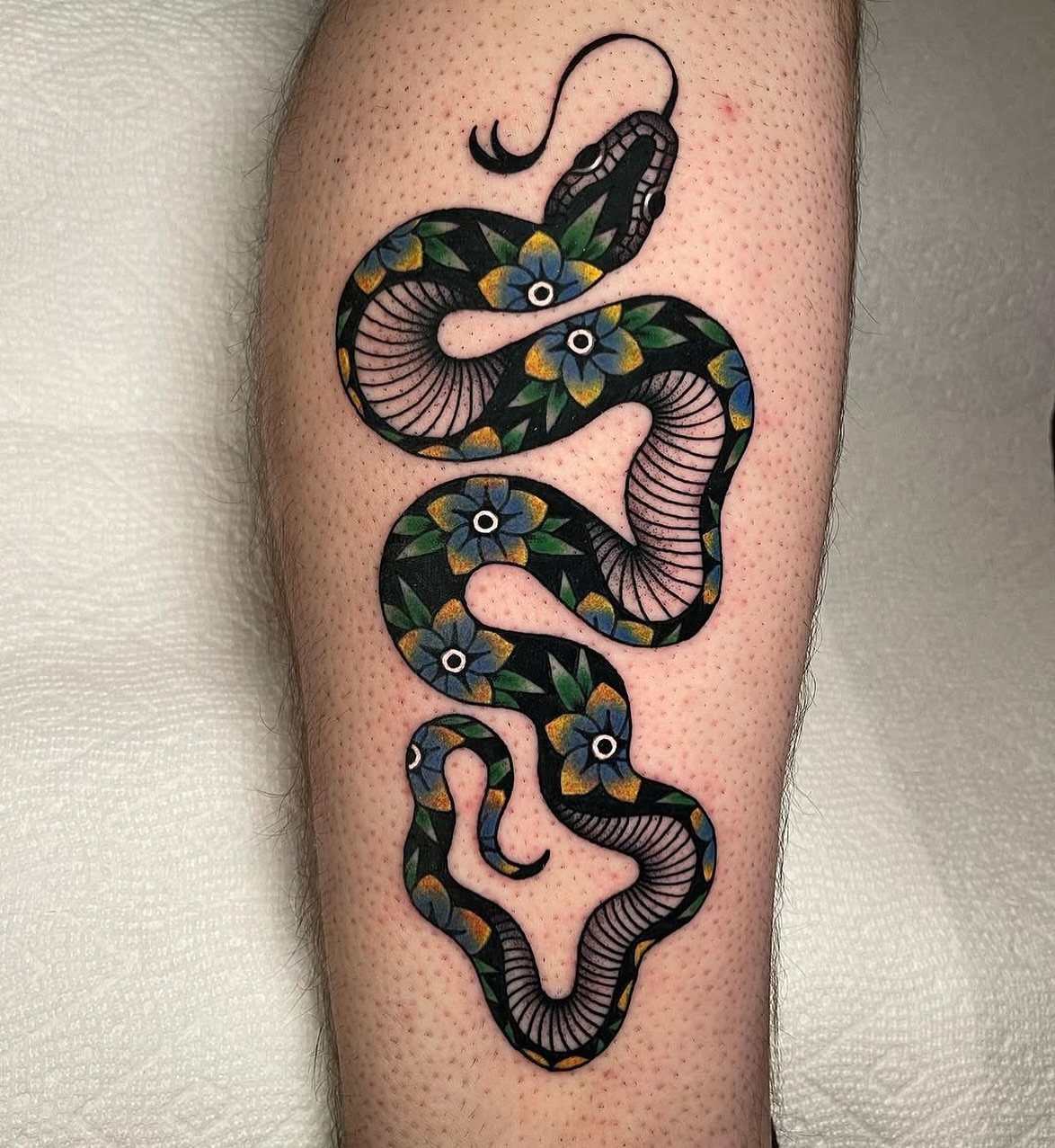
A black snake threaded with blue and yellow flowers merges 2 traditional vocabularies: the danger animal and the decorative filler.
The flowers here are not background; they are woven into the body, which means the artist has to plan the negative space as carefully as the ink.
Blue petals against black scales read cooler than red accents, so this suits skin with olive or neutral undertones better than very warm complexions.
Before you commit, check whether the flower types mean something to you; traditional rose, peony, and chrysanthemum each carry different weight, and mixed without intent they can read as accidental.

MADE IN THE USA SINCE 1990: For over 30 years Dynamic Color has produced professional tattoo ink in the United States, an established American brand artists built their work on long before most imported labels existed.

PREMIUM USA-MADE FORMULA – Eternal Ink is proudly made in the USA in a certified, state-of-the-art facility. Every batch is sterilized and tested to meet the highest industry safety and quality standards.

TRUSTED BY TATTOO ARTISTS FOR AGES – For over ten years, Dynamic has been providing artists with a wide range of top-quality performance colors.
5. Black and Grey Winding Shin Snake
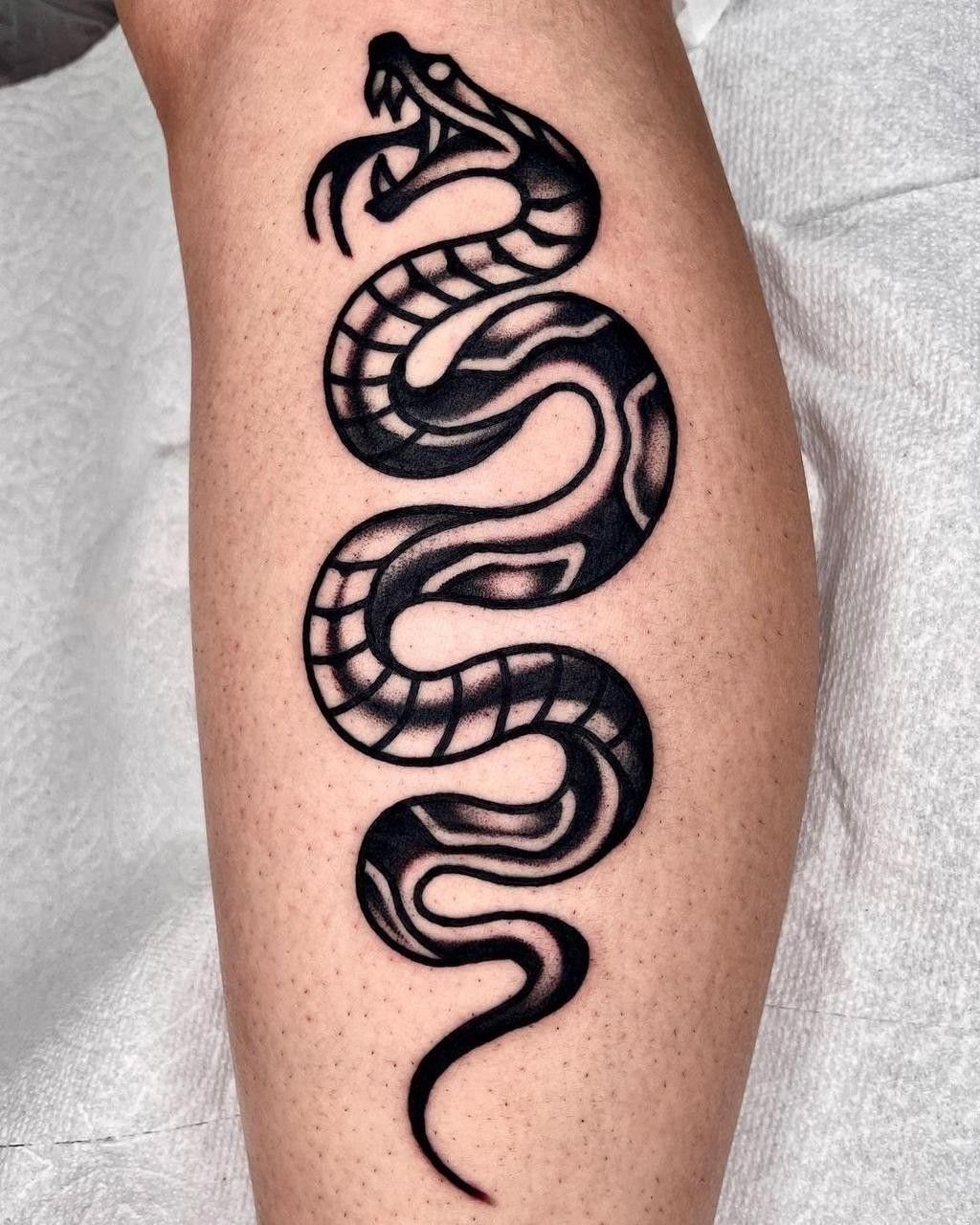
Black and grey winding down the shin in a vertical line follows the bone and lengthens the leg visually.
Without color to separate elements, the shading has to do all the work: whip shading for texture, smooth gradients for depth, and solid blacks for the mouth and eye to give the snake its direction.
This is the faster session and the lower cost entry point into traditional work, and it heals with less risk of patchy color loss.
The limitation is that grey wash can look muddy if the artist rushes the saturation; I would look for healed photos specifically, not just fresh work, before booking.

Snake and Botanical Flowers Stencil: You will receive 9 pieces of painting stencils which have beautiful patterns in animal theme. There are snake and botanical flowers, stars, moon, moon phases, human hands patterns on the stencils. Our templates are suitable for you to make handmade projects by yourself.

UNIQUE DESIGN: You will receive 4 styles of snake and plant pattern wall stencil in same size, each style has different patterns, you can choose different molds according to your own decoration style, and decorate your own room by yourself.

💗【66 Sheets SHELYEXIEN Brand Watercolor Rose Florals Temporary Tattoos For Women Adults】 Fake Sleeve Tattoos For Women Girls Including 3D Gothic Tatoos Universe Planets Star Moon Spider Web Cross Birds Scorpion Bat Ghost Elephant Flower Floral Pirate Compass Anchor Butterfly Serpent Skull Skeleton Maori Totem Animals Wolf Tiger Lion Dragon Eagle Owl Bear Crown Mountain Sea Wave Snake Tree infinity Letter Words Quotes Abstract ECG Feather Gangster Minimalism Coyote Feather Astronaut Whale Lotus Dreamcatcher.
6. Two-Leg Wrapping Snake Tattoo
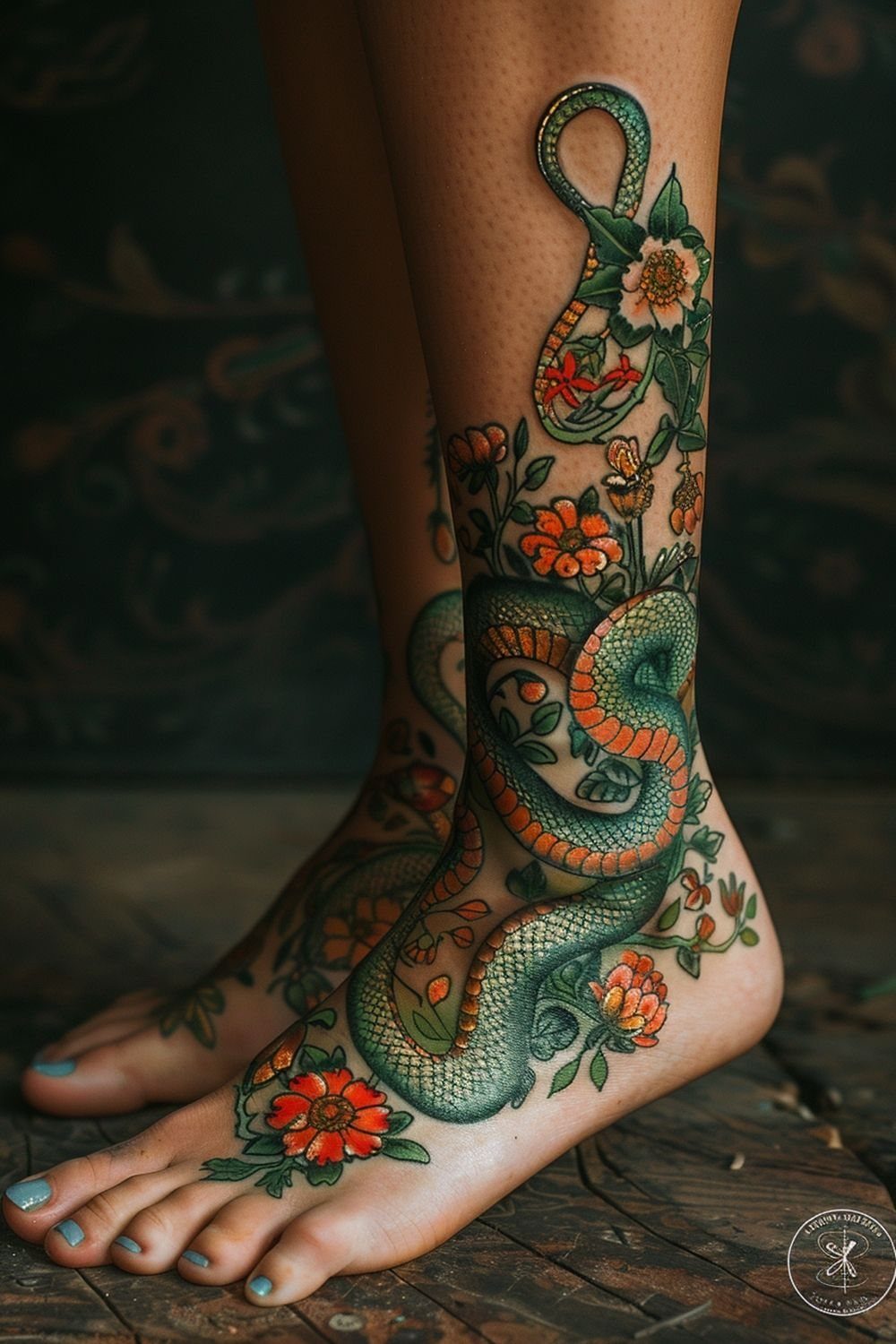
A snake that wraps both legs, ankle to shin, with green and orange scales and floral filler is a commitment measured in years, not hours.
The color matching matters across 2 limbs done in separate sessions; bring reference photos of the first leg when you start the second, and expect the healed green to need a touch-up pass before the orange goes in.
Flowers bridge the gaps where the snake crosses from inner to outer ankle, hiding the visual seams.
This suits someone already heavily tattooed who wants the lower body to read as one continuous piece; for a first large work, the pain and healing of both legs at once is a lot to manage.


Halloween Face Tattoos: You will get 2 sheets Medusa Face Tattoos, and 2 sheets Snake Scale Temporary Tattoos, in 4 different designs. Our Medusa Face Stickers are most suitable for festival, Halloween, costume contest or themed party.

Snake Stencil: You will receive 3 pcs animals theme stencil with various forms of snakes pattern. Reusable DIY plastic stencil that can bring fun to your daily DIY projects, perfect for snakes lover for house decorating! Add a splash of color to your life
Frequently Asked Questions
What does a snake tattoo on your leg mean?
A snake tattoo on the leg carries the same core meanings as snake imagery anywhere: rebirth from shedding skin, protection, and the duality of danger and wisdom.
On the leg specifically, the coiled or striking pose plays against the muscle and bone to emphasize tension and readiness. I see people choose this placement when they want the symbolism tied to forward motion or standing their ground.
What is a good shin tattoo?
The shin punishes ink with sun exposure and constant sock friction, which is why designs built from bold black lines and packed color hold up where finer work would blur into a mess.
The coil of a snake works especially well there; the curve of the leg gives the design natural tension, and placing the tightest detail just off the shinbone ridge lands on flatter muscle that carries ink better and hurts less.
Bold work that reads from a distance ages better on the shin than fine lines or heavy grey wash.
Which tattoo to avoid?
On the shin, avoid designs with fine lines or heavy reliance on yellow and light colors that fade fast under sun and friction.
A two-leg wrapping piece is also a lot to manage for a first large tattoo; the healing of both legs at once, plus the color matching across separate sessions, is better suited to someone already used to long sittings.
If the artist only shows fresh photos and no healed work, that is a flag too, especially for grey wash that can muddy over time.