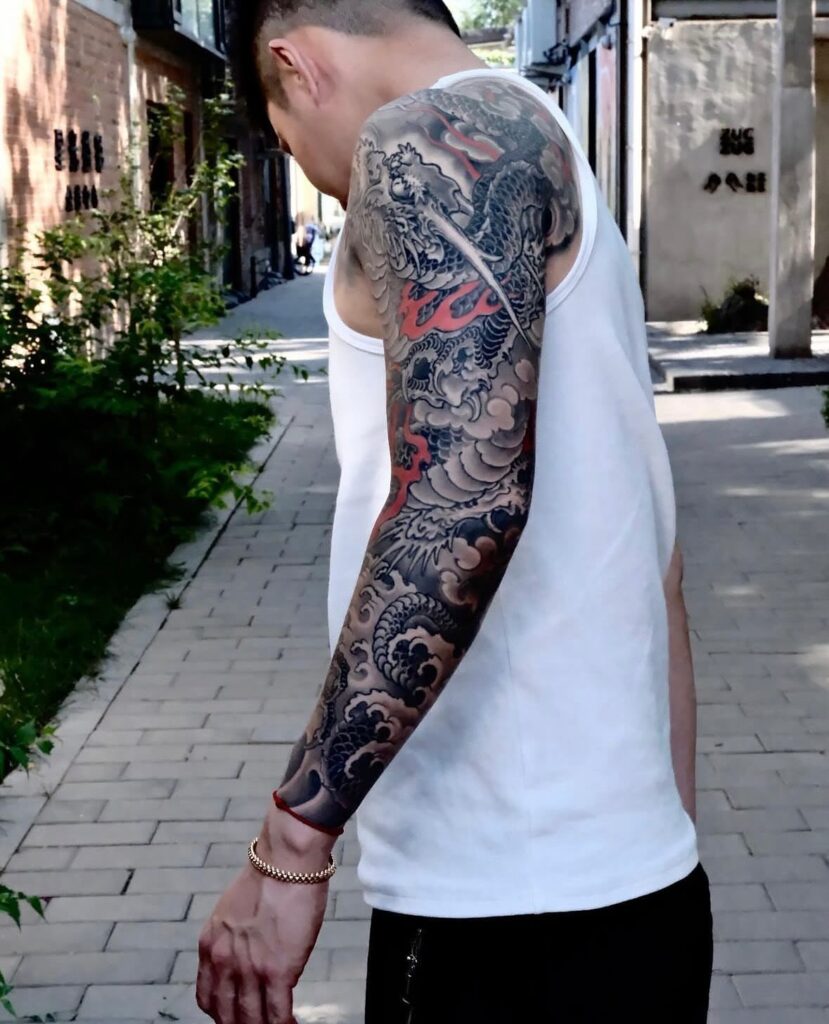
These 19 Japanese dragon tattoos range from a single forearm wrap to full leg and back pieces, plus notes on color choice, cultural meaning, and how traditional methods still shape the work.
What separates one design from another is not style alone but the story you want the dragon to carry: cherry blossoms for impermanence, a sacred pearl for guarded wisdom, Fudō Myōō for spiritual weight, or maple leaves, spider lilies, and pairing with koi, samurai, or oni masks for their own layered meanings.
Tebori hand-poke work still exists too, though in the US the artist pool is small enough that some collectors fly to Japan for it.
[link-whisper-related-posts]1. Dragon with Cherry Blossoms
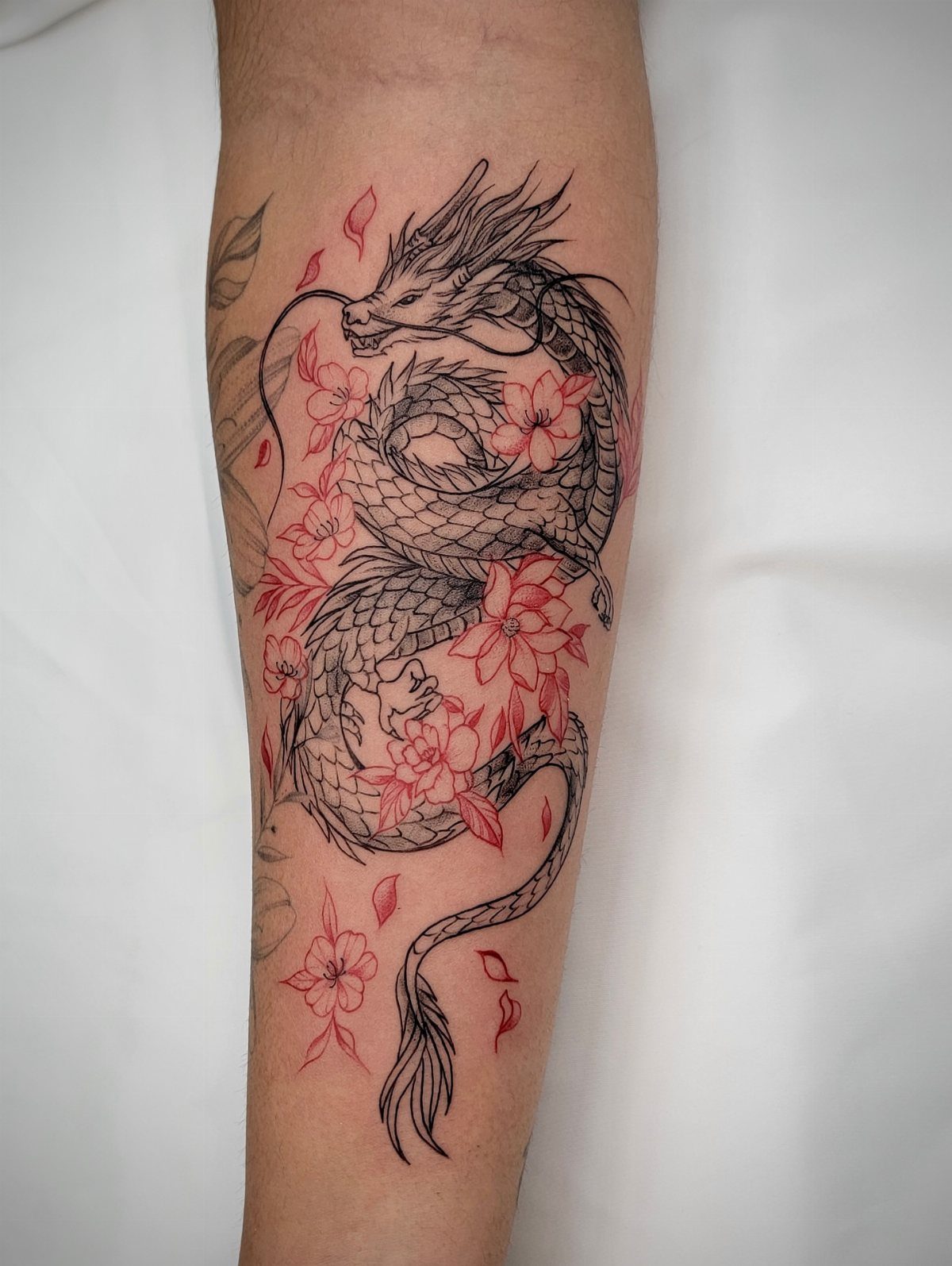
This pairing lives in the tension between what lasts and what doesn’t. Cherry blossoms live brief lives next to a creature that outlasts dynasties; the pairing is older than most nations.
That contrast is what makes it work visually, red petals and falling pieces against dark scales, and what gives it weight as a choice.
Let the blossoms drift down an arm or across a shoulder the way they actually fall, filling gaps without looking plotted on a grid.
I would ask the artist to let some petals drift away from the dragon entirely, so the composition breathes. A sleeve or shoulder cap suits this best; the falling motion needs room to read.
Color here is worth considering carefully.
Red ink against black-and-grey grabs the eye first, though pink tends to wash out years before the dragon loses its punch. Plan for touch-ups or keep the blossoms minimal.

6 Japanese Style Design Sheets – Traditional dragon, koi fish, phoenix, and samurai artwork gives you an authentic full-arm sleeve look in one easy application.
2. Koi and Dragon
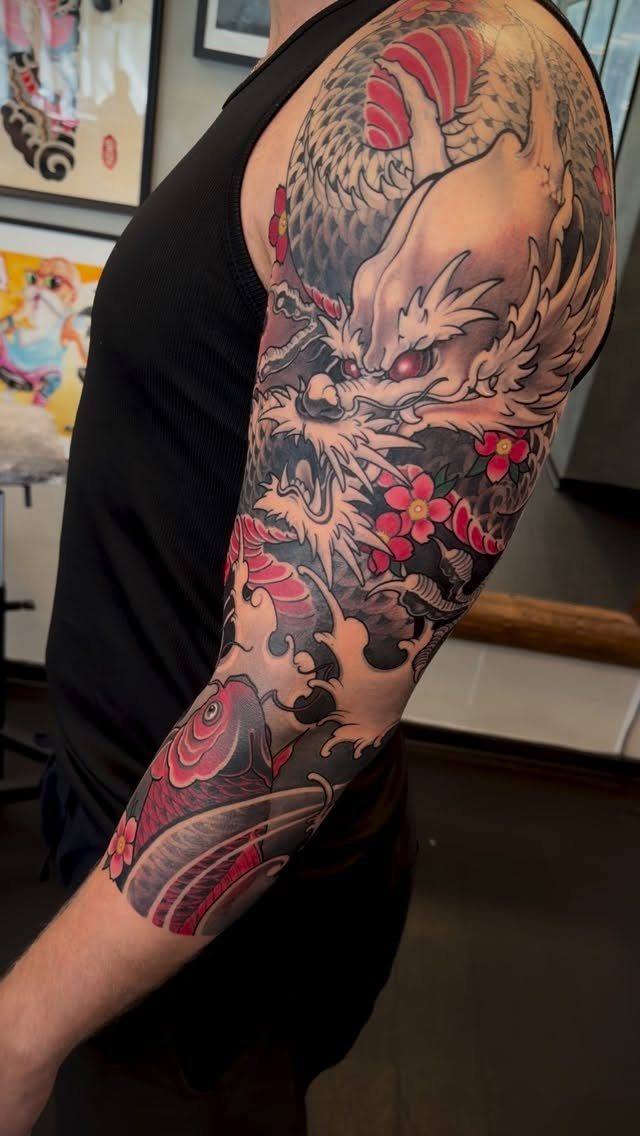
The koi’s transformation into a dragon is one of the heavier stories in Japanese tattooing, and people tend to arrive at it after something real.
Koi swim below, dragon rises above, water threads between them; the arrangement is standard for a reason.
That upward sweep follows the thigh-to-hip line or a full back the way muscle already runs.
Orange koi against blue or black dragon gives the eye 2 poles to move between. If the transformation moment itself doesn’t appeal, both creatures can appear as separate states of one journey instead.
Pain and time run high on this one.
A full composition with water and both figures is multiple sessions, and the areas that show it best, ribs, hip, thigh, are not forgiving. Budget for the long haul.
3. Coiled Dragon Sleeve
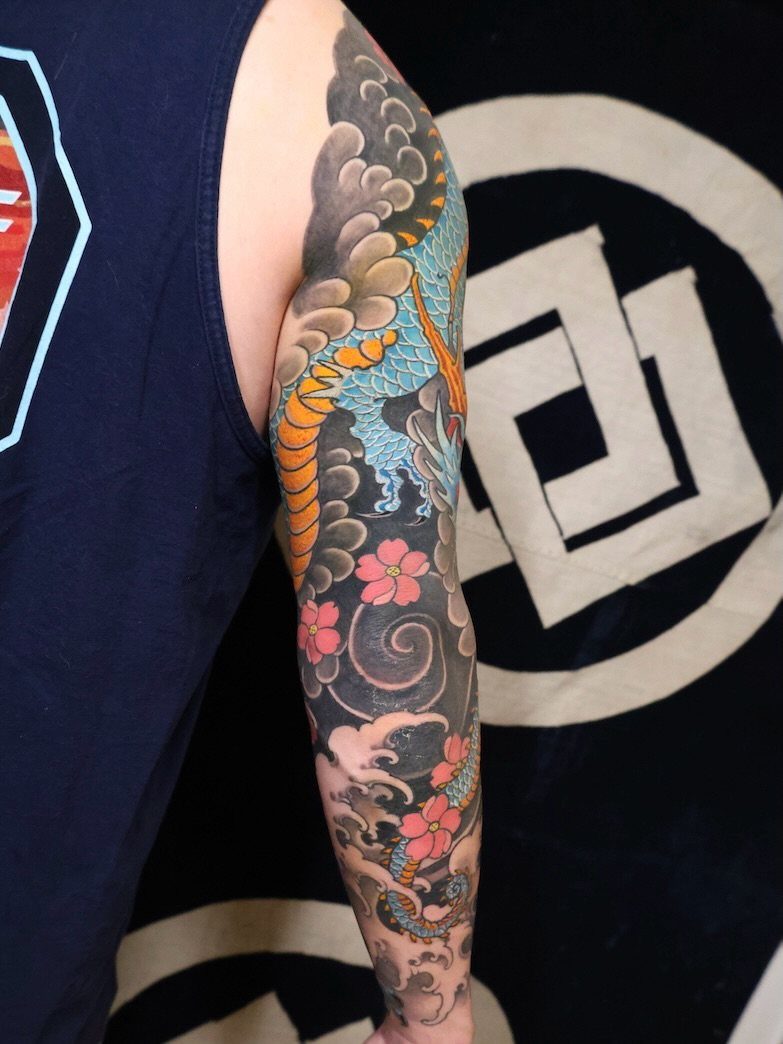
A full sleeve is a commitment in hours, money, and visibility. The coiled dragon makes that commitment the point; the wraparound shape uses your arm’s muscle structure so the dragon seems to move when you flex.
Let the artist map this before any ink touches skin.
The flow around the elbow, the way the coils tighten at the forearm, these are placement decisions you cannot adjust later. What reads from the front should also hold up when your arm hangs at your side.
Color or black-and-grey both hold up; blue and orange against dark clouds works here, but the coiling motion itself does the heavy lifting.
A sleeve this dense spreads across months of sessions, each one swelling and healing before the next. Healing between sessions matters more on a sleeve than on smaller work, the skin needs rest.
4. Black Dragon Tattoo
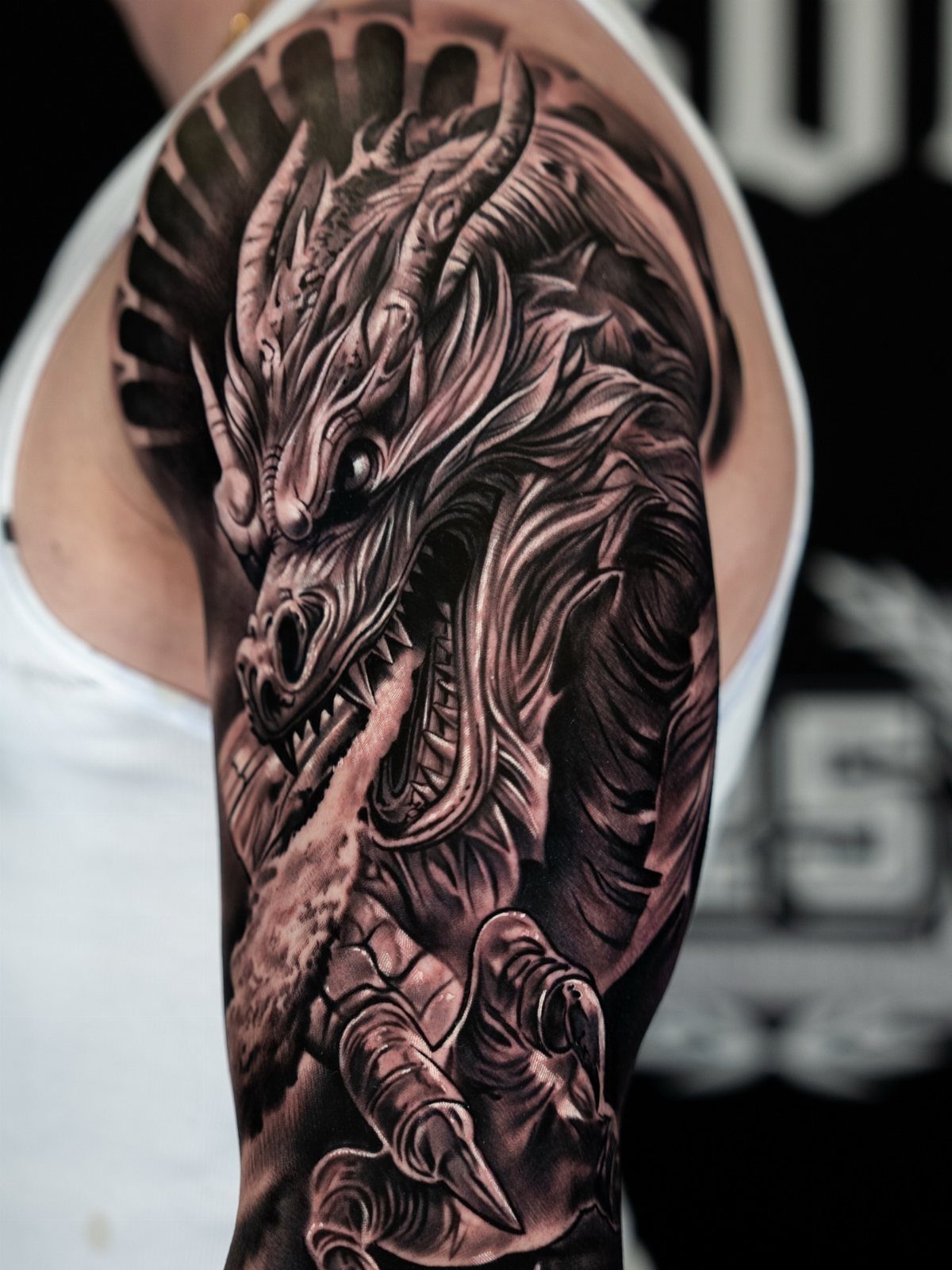
Black and grey forces every bit of attention onto linework, shading, texture; there is nowhere to hide.
Scales, claws, flame, none of it needs color to register as what it is. That focus is the draw, and it ages better too; black holds integrity where color fades unevenly.
Ask to see healed photos from your artist, not just fresh work. In black and grey, the depth has to be built into the initial application, touch-ups can only do so much.
This style suits detail-heavy compositions on the shoulder, back, or chest, anywhere the artist has space to build layers of grey.
If you want the dragon to feel ancient, weathered, this is the palette.

Temporary Tattoo Sticker Material: 100% waterproof and can last up to 5-7 days,so you can wear them at beach or pool parties all the summertime. Dimensions : 10 cm * 20.5 cm...
5. Peony and Dragon
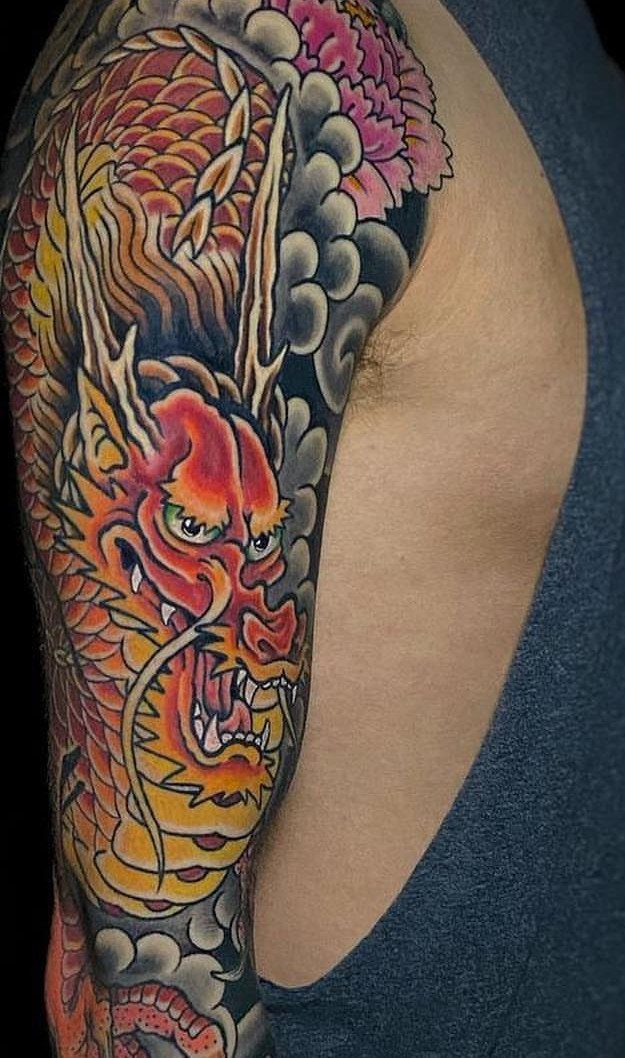
Peonies carry weight in Japanese tattooing, wealth, honor, royalty among flowers.
Set against a dragon, they make the power feel earned rather than raw. Layered petals build a dense field behind the dragon so the eye has somewhere to rest without the composition going flat.
This pairing needs space.
Both elements are dense; cramming them onto a forearm wastes what each can do. Back or thigh gives the peony’s full bloom and the dragon’s body room to coexist.
Orange and red dragon against pink peony with dark clouds follows the old color story, though the real tension is between soft petal and scaled hide, something that reads just as true without ink color at all.
I would place the peony lower in the composition, letting the dragon rise above it. That hierarchy reads immediately.

【Complete Tattoo Kit】Dragonhawk poke beginner tattoo kit includes the original poke pen, professional needles, tattoo design images, covers, and essential supplies
6. Ryu Tattoo
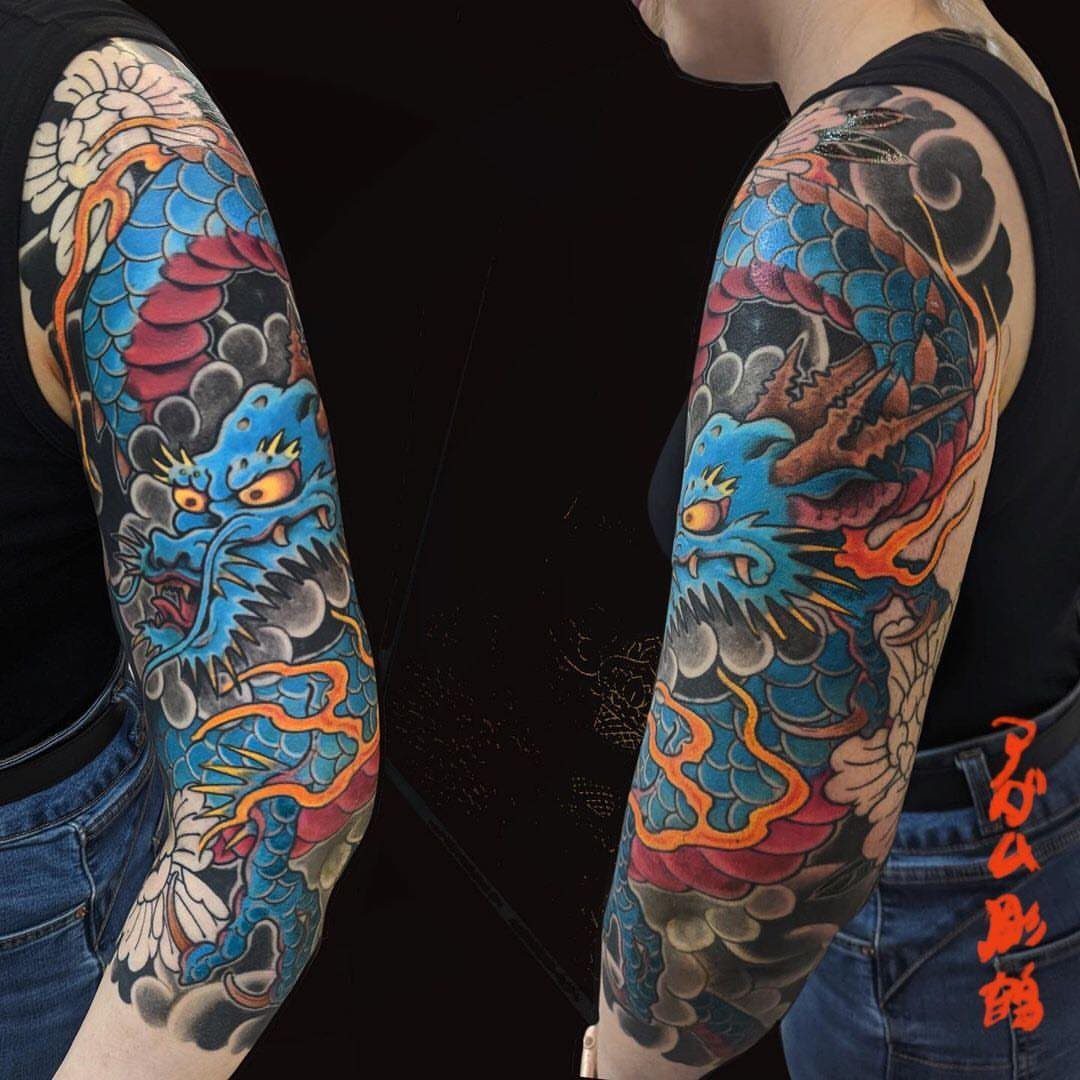
Ryūjin, the sea dragon deity, is the most traditional form: long serpent body, clawed feet, usually coiled, usually accompanied by clouds or waves.
Blue scales with flames and Japanese characters fill the whole arm, a newer take on a template centuries old.
The coiled position is not just aesthetic; it references the dragon’s connection to water, to weather, to natural forces rather than human affairs.
Characters or inscriptions can add meaning, but check the translation yourself. Do not rely on the artist’s reference sheet.
This is the design people picture when they say "Japanese dragon," which is either exactly what you want or a reason to choose something less expected.
The commitment is substantial, a sleeve or larger, and the style demands an artist who works regularly in traditional Japanese methods, not just someone who can render a dragon.


7. Blue Dragon Tattoo
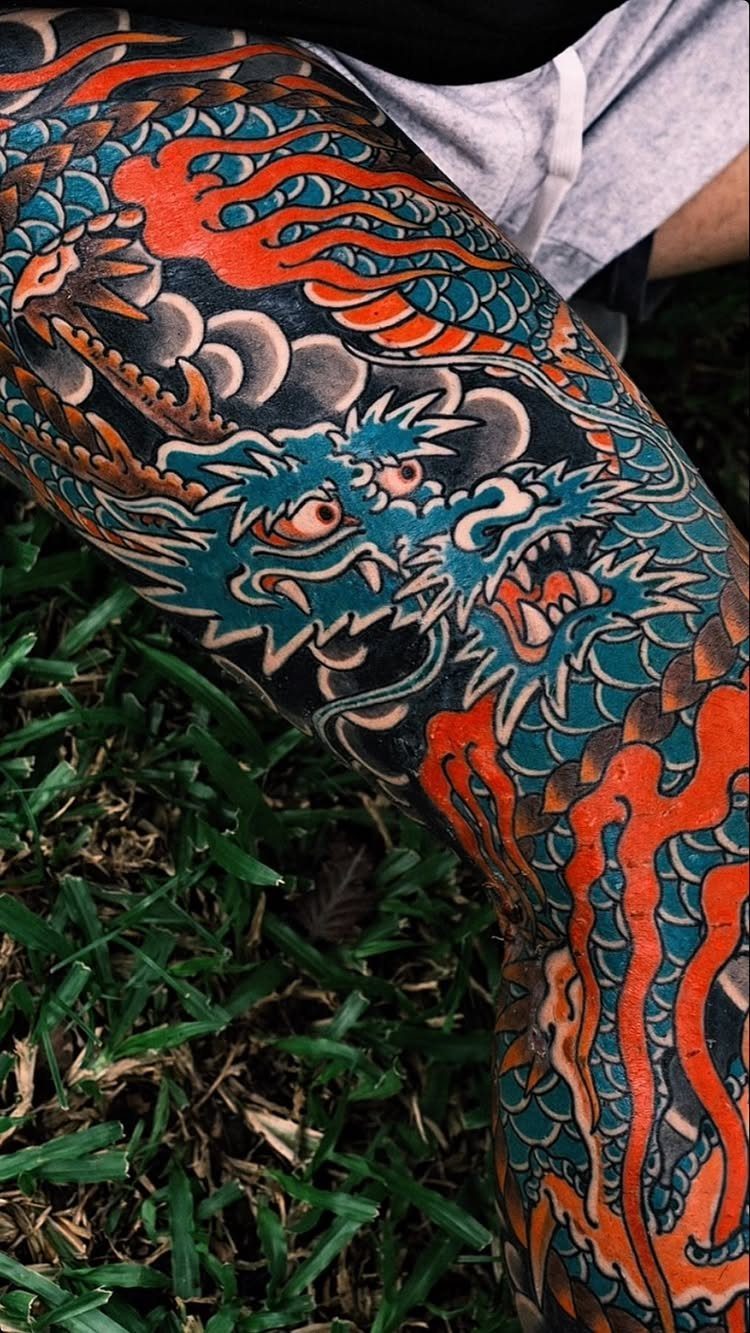
In Japanese tradition, blue dragons guard the east and spring, a protective station rather than an attacking one. The calm reads differently from red or black dragons; there is authority without threat.
Wind bars, those diagonal black lines that stand for wind in Japanese art, keep the composition from going static.
Teal and blue against orange flame gives a temperature contrast that still reads from across a room. Cool tones against crisp black wind bars read as graphic even when the details blur.
A leg placement like this one needs the muscle curve to sell the coiling motion. Ask your artist to map how the dragon’s body follows your own lines when you stand.

Soft Fleece Comfort: Made from a soft cotton blend with a warm fleece lining, this men's graphic hoodie provides cozy warmth and a soft feel in cooler weather, while the regular fit creates a clean silhouette for comfortable everyday wear

Embrace the power the dragon with our Japanese Dragon inspired design, featuring a fierce creature in the iconic style of Dragon tattoos. For anyone who loves Asian culture and mythology
8. Dragon Head Tattoo
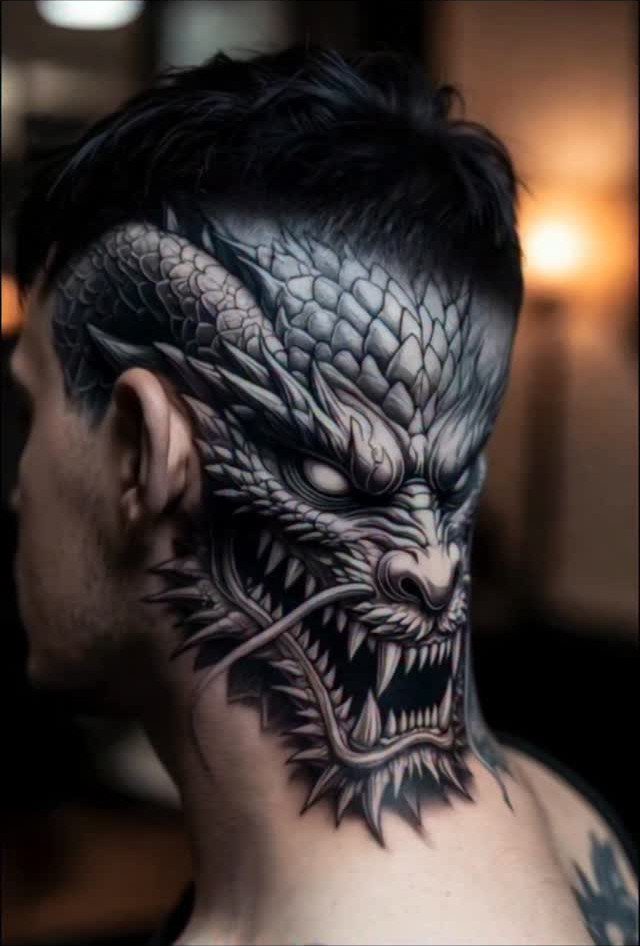
A head tattoo is not a place for hesitation.
The skin is thin, the bone close, the pain sharp and sustained. What you gain is a surface that holds detail the way a flat wall holds paint; the dragon’s face can carry expression no coiled body allows.
Black-and-grey work this detailed shows scale texture and eye intensity that would flatten on a curved limb.
Shaved or short hair is not optional; the tattoo becomes part of your daily presentation. Regrowth rates vary, plan for maintenance or commit to the look.
Healing on the scalp is faster than most placements, though sleeping requires adjustment. The artist needs experience with head texture specifically; not every shop will take this on.

🐳[8 Sheets Black Dragon Tattoos in One Package!] - Original Brand of TASROI 3D imperial loong Tribal Dragon Temporary Tattoos For Women Men and Adults. Tattoos Temporary Contains 8 Large Sheets Water Transfer Animals Dragon Floral Flower Rose Moon Serpent Totem Armband Etc.
Embrace the power the dragon with our Japanese inspired design, featuring a fierce creature in the iconic style of Tokyo tattoos. The intricate kanji script , making this the perfect gift for anyone who loves Asian culture and mythology

1.Vintage black grey oriental designs including ocean waves, dragon and hannya mask. Rich layered shading creates realistic tattoo visual effect. 2.Made of premium water transfer material. Resists daily shower and sweat, the detailed patterns stay clear for days. 3.Designed for forearm, upper arm and shoulder. The large sheet fits arm perfectly to create stunning half sleeve body art. 4.Place tattoo flat on skin, press with damp cloth for 15-20 seconds to transfer. Wipe off with skin oil or alcohol with no sticky residue.
9. Dragon Clutching Sacred Pearl
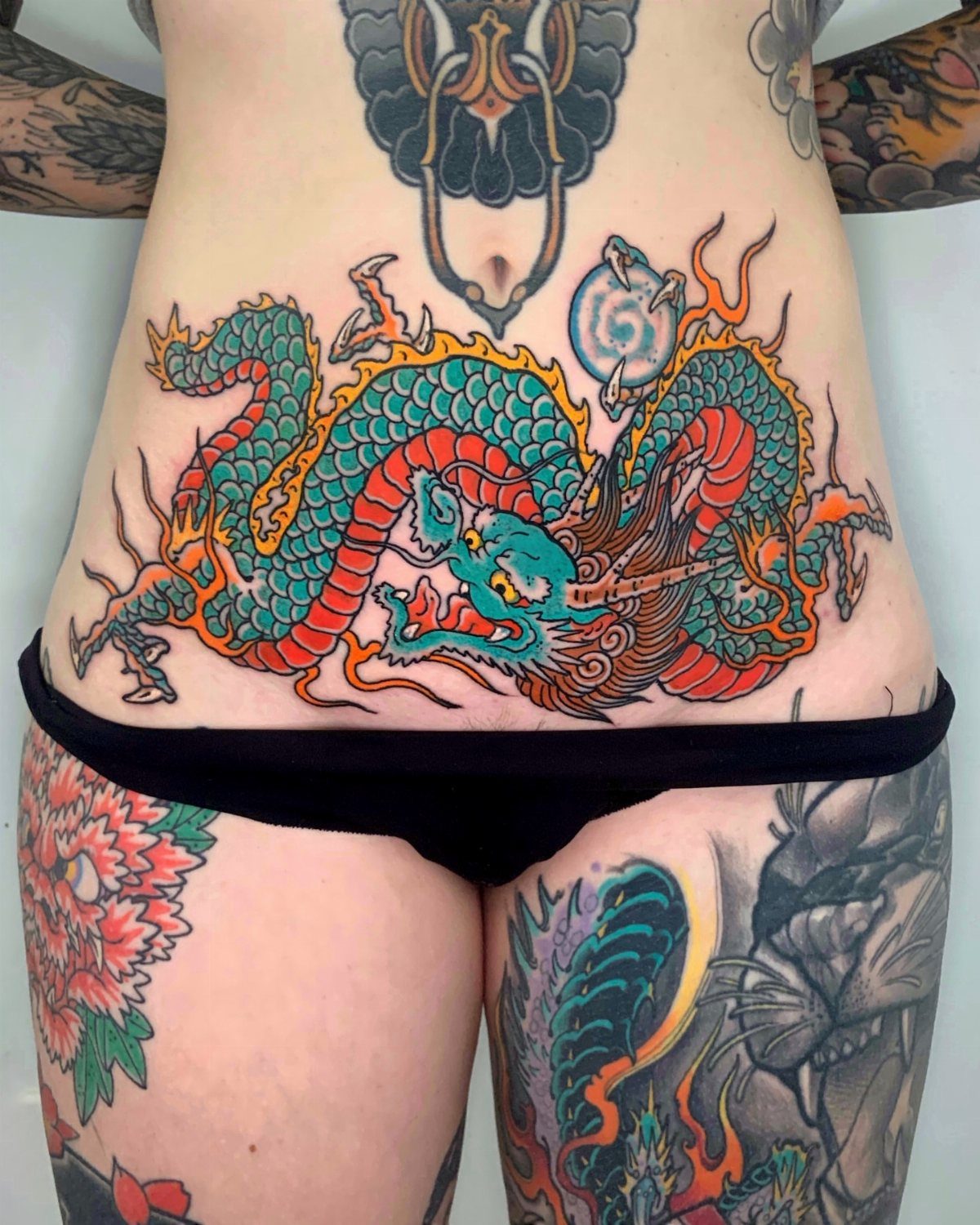
The pearl is the center of gravity here, not an accessory.
In Japanese tradition it grants wisdom or commands tides; the dragon does not clutch decoration, it guards power. That shifts how the composition should read.
A stomach placement can use the body’s natural curve so the dragon coils around the pearl rather than flattening across it.
The teal and red hold saturation on torso skin, which takes ink well and ages relatively evenly. A soft inner glow on the pearl, built through careful grey shading, sets it apart from the sharp scales around it.
This is high-commitment placement for a high-commitment symbol. The stomach moves, stretches, changes with weight; the design needs slack built in.
10. Fire-breathing Dragon
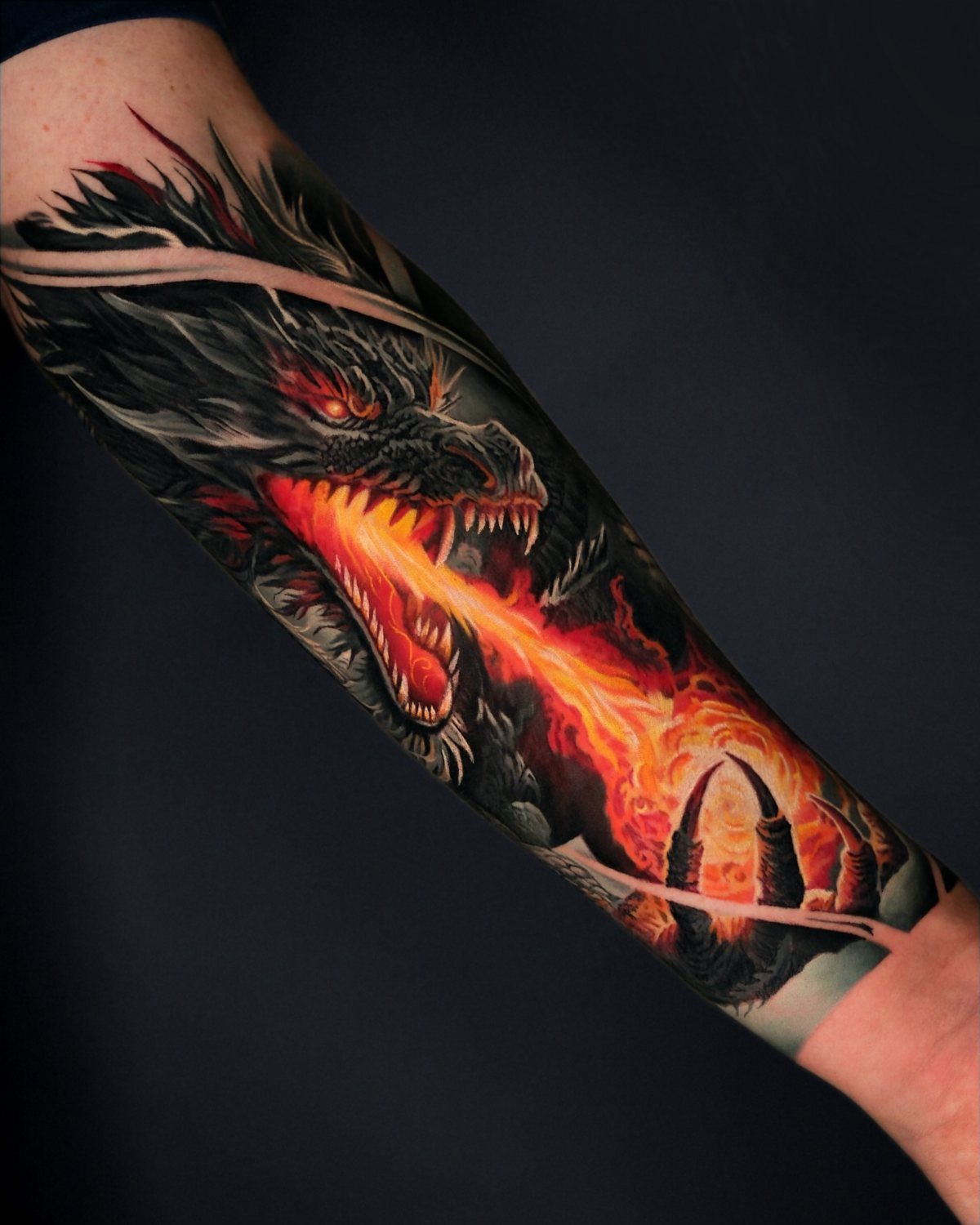
Japanese flame work follows its own rules, not the ones you’d learn from observing a campfire.
The kaen in traditional prints curls in ribbon shapes, stylized and alive, and that is what separates a collected piece from a generic dragon breathing generic flame.
A forearm wrap gives the flame room to start at the mouth and continue as background fill, becoming structure rather than afterthought. The dark background lets both dragon and flame read immediately.
Movement is the point.
Static flame kills the energy; the shapes should look like they are still curling. Reference actual woodblock prints with your artist, not other tattoos.

Adjustable Needle Protrusion:Easily fine-tune your poke depth — this cartridge hand poke tattoo kit features an adjustable cartridge grip and end knob for precise control. Perfect for both fine lines and bold fills in any poke tattoo kit setup.

DIY HAND STICK N POKE TATTOO KIT -“Stick and Poke” is a kind of tattooing that involves using a sharp point and some “ink.”It is an ancient form of body art that has thought to show various significance in the long history of human experience on earth. Our Tattoo Kit comes with everything you need to safely and cleanly hand poke beautiful tattoo art at home.

【What's In The Package】The complete professional stick and poke tattoo kit are suitable for learners, beginners, and tattoo artists. The package contains a stick and poke tattoo pen, tattoo needles, tattoo grip wrap, Tattoo needle pads, tattoo ink, tattoo ink cups and so on.
11. Dragon with Fudō Myōō
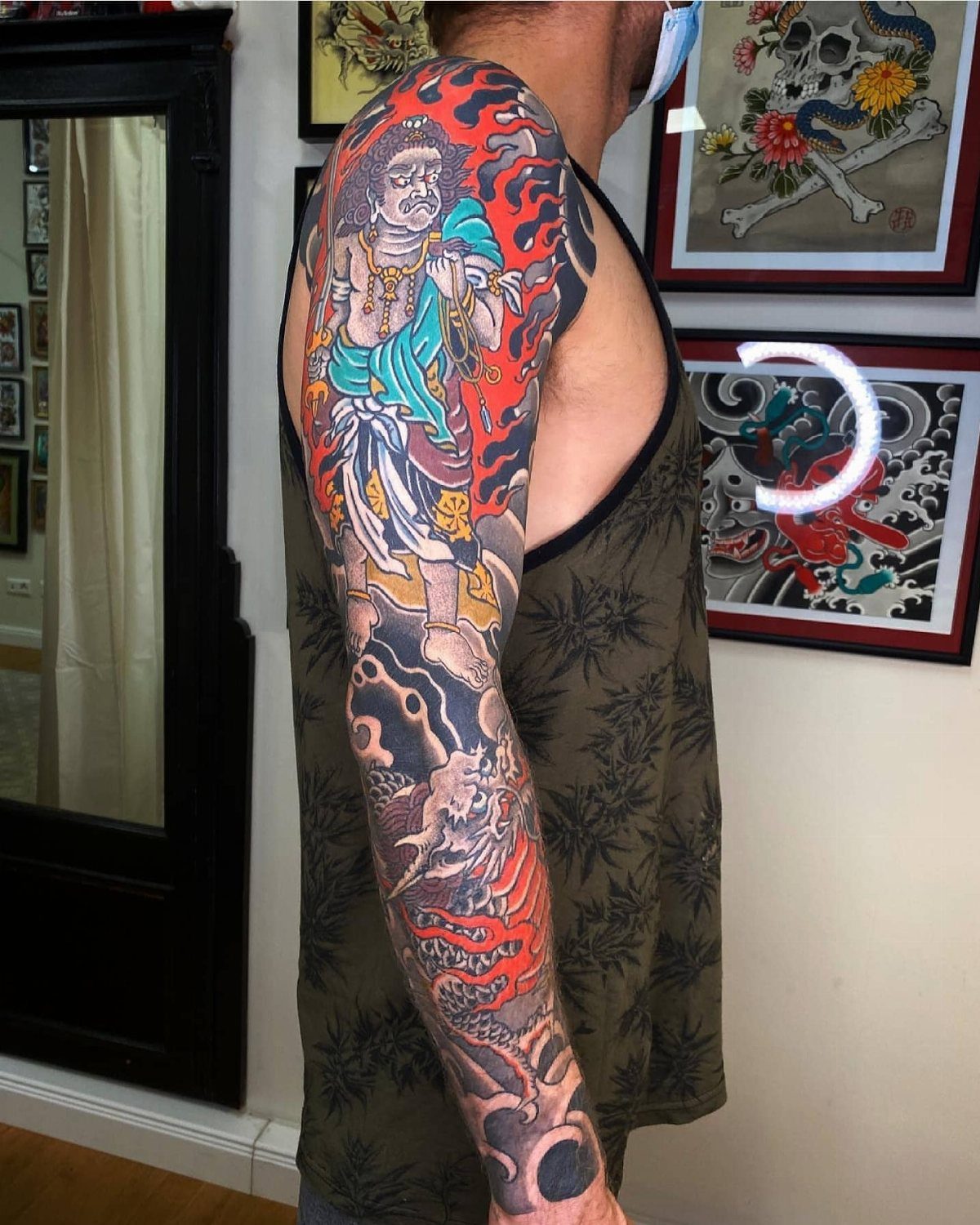
Fudō Myōō is not a decorative addition. The Buddhist deity of immovable wisdom and fierce protection changes what the dragon means in his presence; this pairing belongs to people who want the spiritual weight, not just the visual impact.
A sleeve can separate them vertically, deity above and dragon below, each given room to read fully.
Flames surround Fudō Myōō by convention, sword and rope in hand; the dragon wraps or emerges behind. The pairing needs an artist who understands Buddhist iconography, not just someone who can draw a convincing dragon.
Research both figures yourself before the consultation. The symbolism is specific, and working with it rather than around it is what makes the piece hold up.
12. Dragon and Maple Leaves
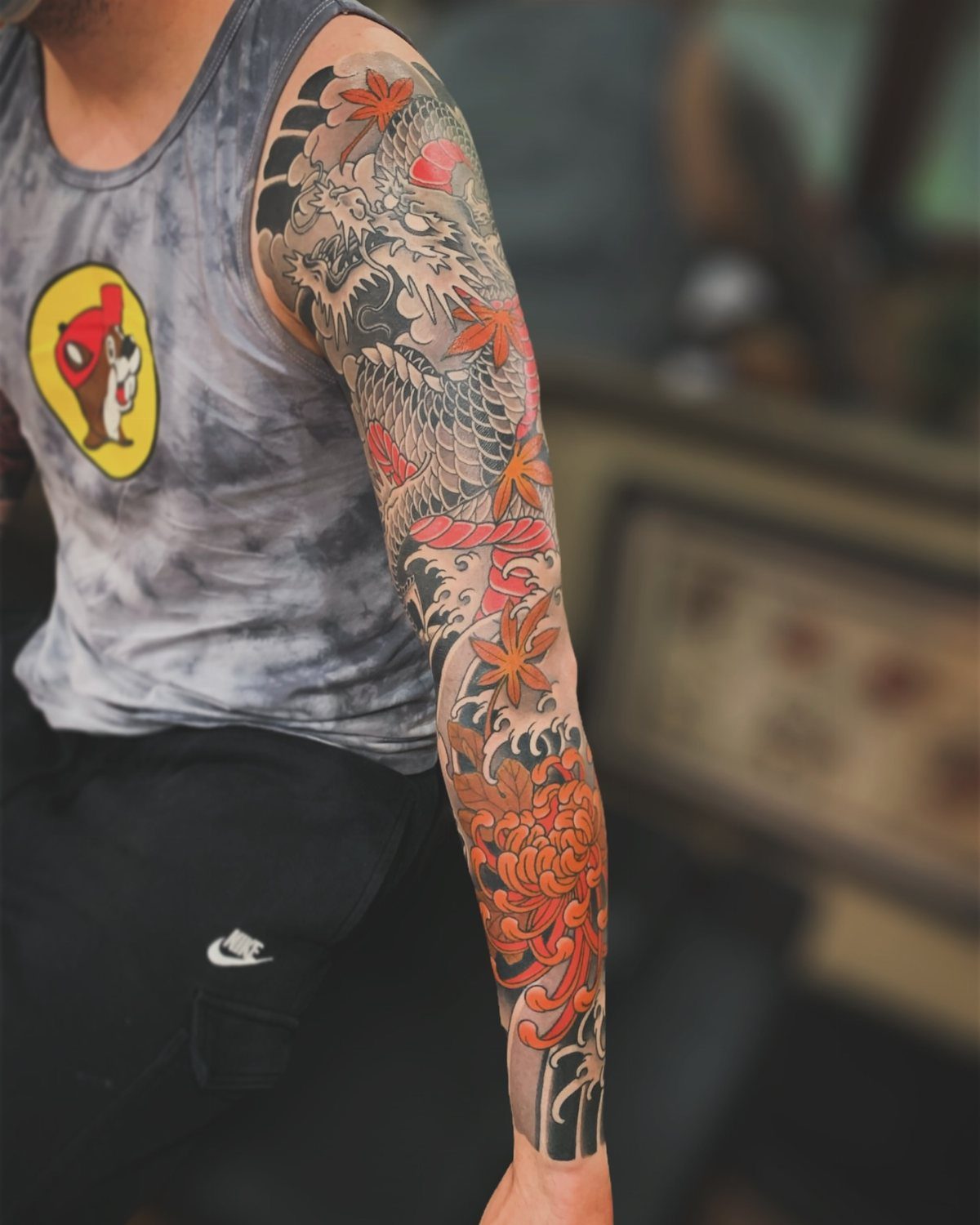
Maple leaves mark autumn and impermanence in Japanese symbolism, the same season-change logic that makes cherry blossoms matter. Against a dragon that outlasts human memory, the pairing becomes a conversation between what passes and what remains.
Red leaves read as motion against the dragon’s fixed presence, scattered rather than arranged. Red maple leaves and a chrysanthemum sit together here, though the leaves alone would carry the contrast.
A full sleeve gives the elements room to breathe without crowding; forearm or smaller placement would force the dragon to compete with its own background.
Color choice matters for longevity.
Red maple leaves hold better than pink cherry blossoms, but still plan for softening over years. The dragon’s black and grey structure will outlast the foliage; build the composition so it reads either way.
13. Japanese Anime Dragon Tattoos
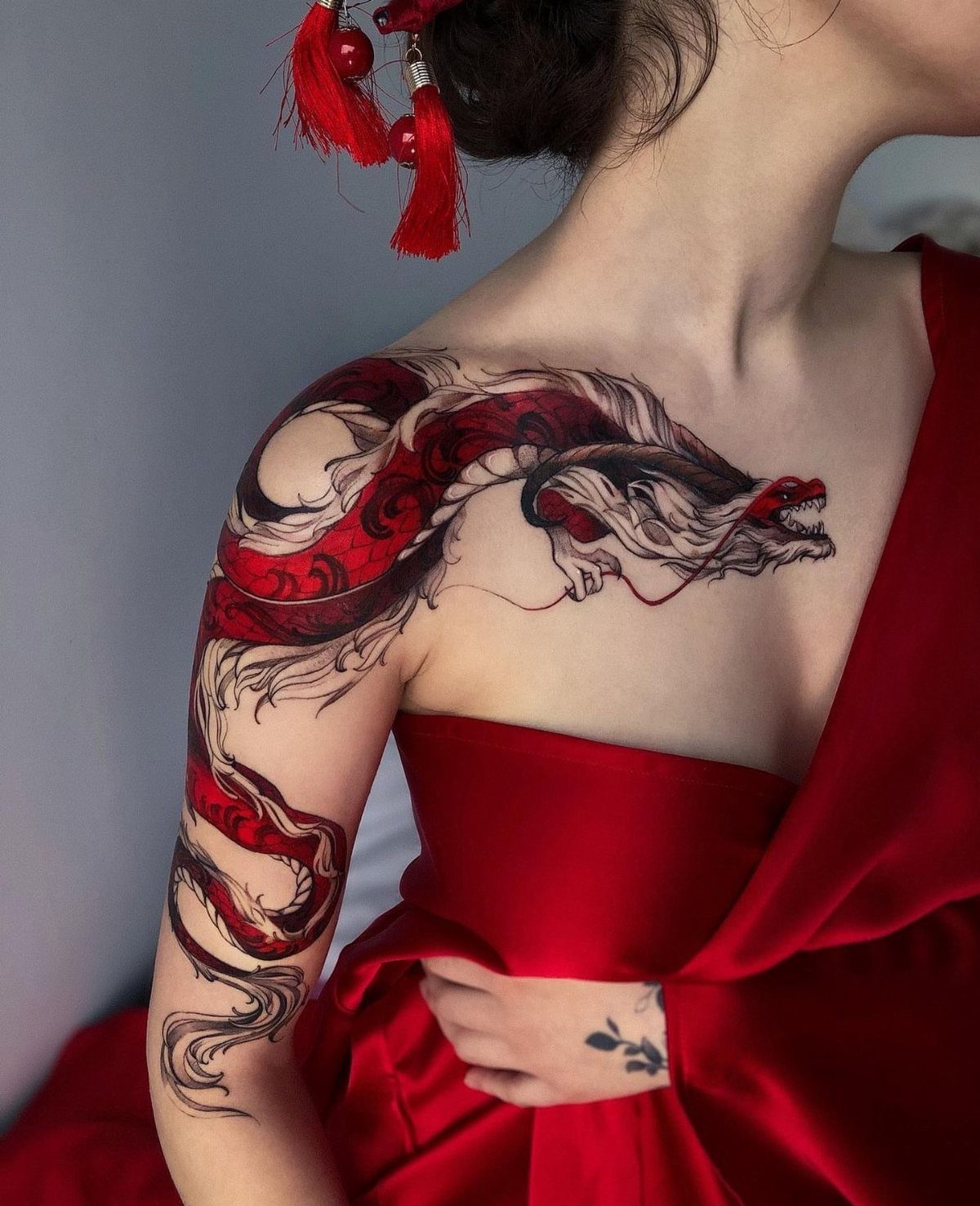
Anime dragons pull from decades of established design language, so the reference material is already rich.
Kaido from One Piece, Shenron from Dragon Ball, each carries color stories and proportions that read instantly to anyone who grew up with the shows.
The risk is dating yourself. A series that drops out of conversation fast leaves the tattoo orphaned.
Stick to titles with sustained cultural weight, or treat the anime element as one layer among traditional Japanese background, clouds, wind bars, so the tattoo holds up even if the reference fades.
Red and black against skin tone follows both anime convention and traditional irezumi palette. An artist who works in both styles, not just one, keeps the balance from tipping too cartoonish or too stiff.
14. Dragon with Spider Lilies
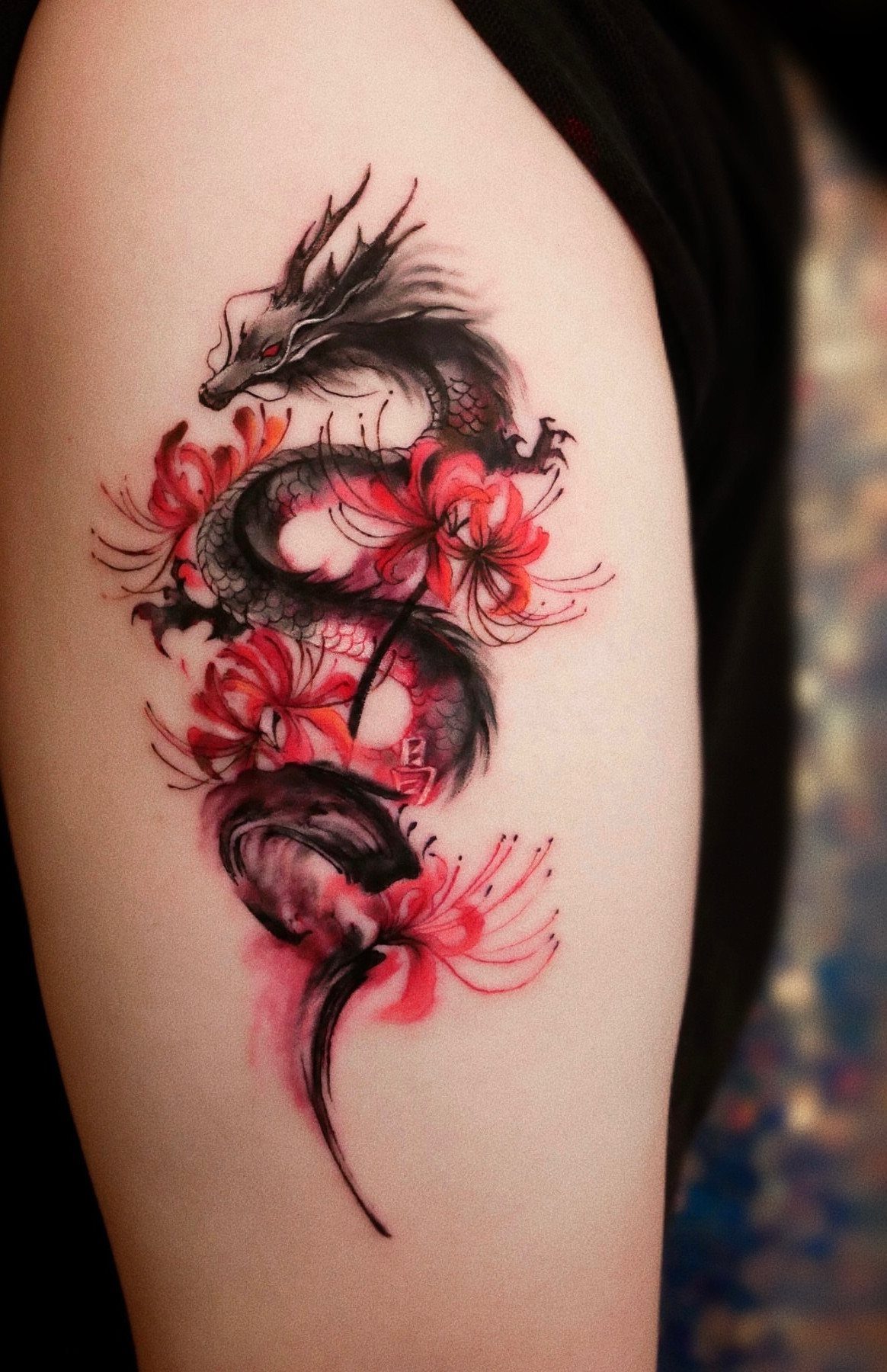
Red spider lilies mark final farewells in Japanese tradition, the flower of cemeteries and afterlife crossings.
Against a black dragon in ink-wash style, the red pops with almost violent intensity, and the pairing asks more of the viewer than decorative dragon work.
The ink-wash approach needs an artist who understands negative space; the dragon’s body emerges from washes and dry brush texture, not outlined scales. That softness against the sharp red blooms creates the tension that makes this piece work.
Healed, the washes can muddy if applied too densely. Ask for healed photos of similar work, and expect the red to settle softer than it appears fresh.
15. Dragon and Compass Leg Tattoo
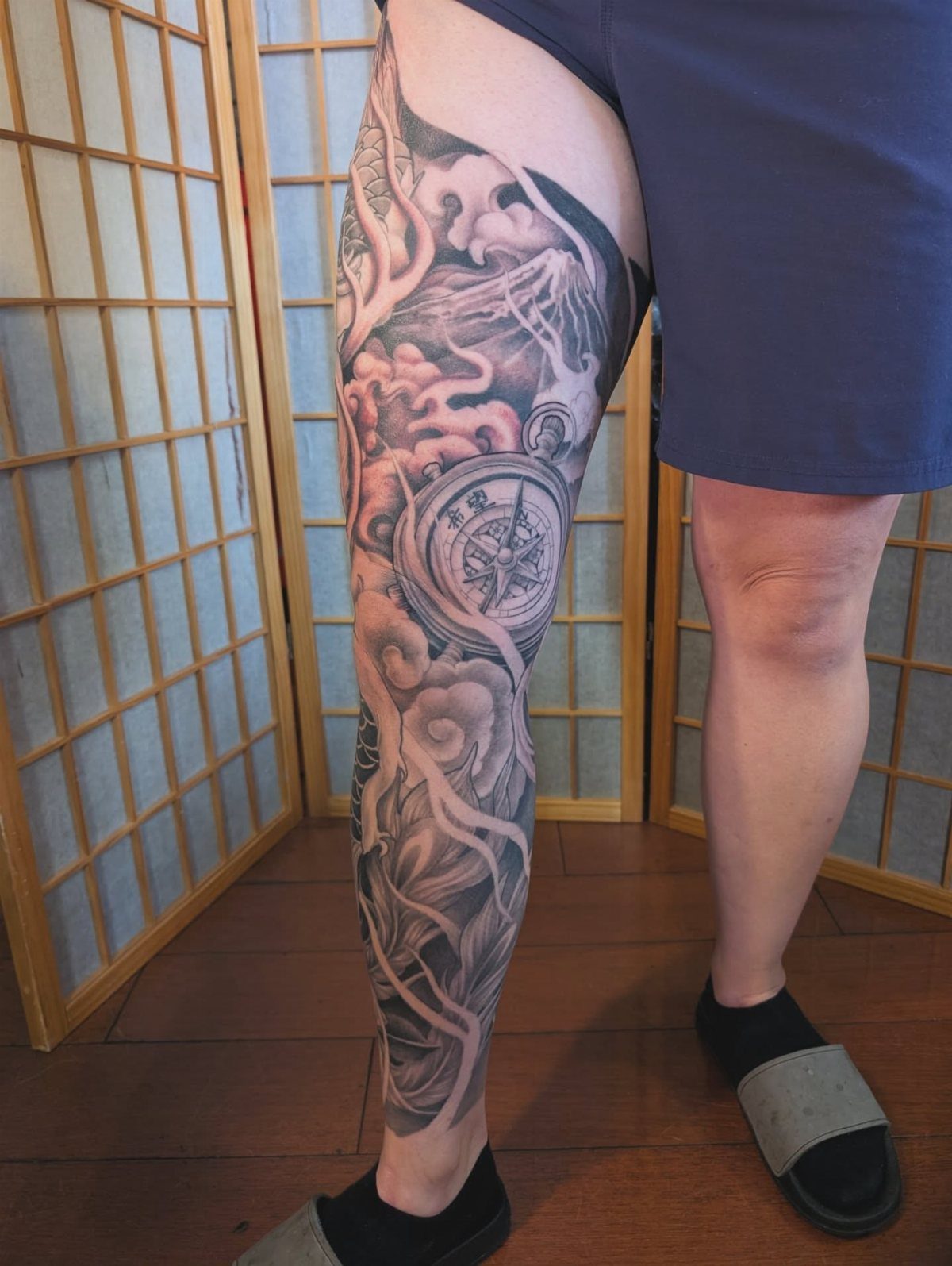
A compass dropped into Japanese dragon iconography is not traditional, but it solves a real problem: the dragon needs a focal point, and the pearl or sun can feel expected.
The compass gives the eye a center without repeating what every other collector carries.
Black and grey across a full leg is multiple sessions, the knee and shin bone especially slow going.
The compass sits where the dragon’s coils allow it to read upright, a placement choice that has to be mapped before any linework starts.
Mount Fuji and clouds fill the background the way waves would in older work. The mix reads as travel narrative, personal direction, without losing the Japanese visual structure.
16. Full Leg Japanese Dragon Tattoo
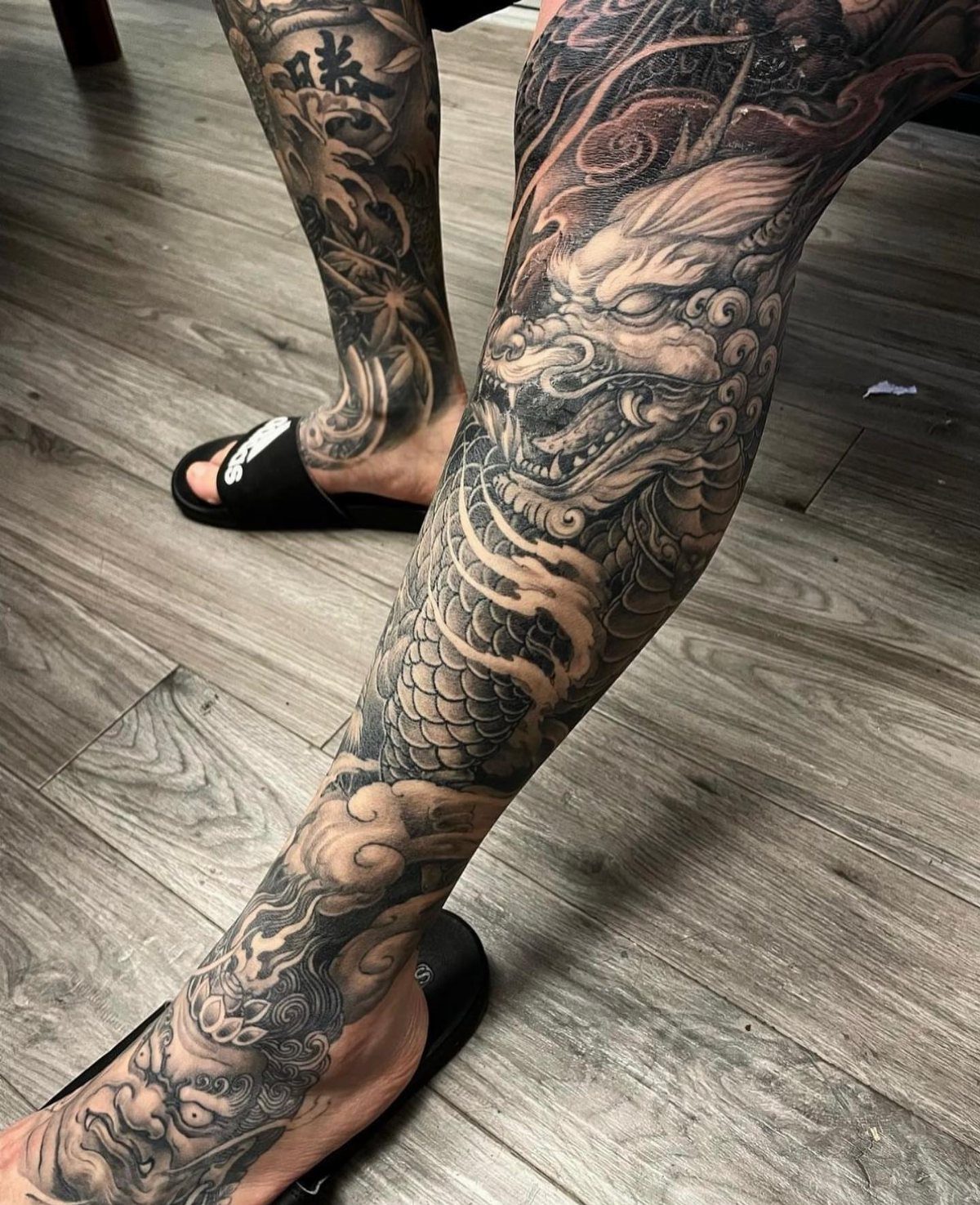
Full leg coverage in black and grey lets the dragon descend from thigh to foot without the composition breaks that come from smaller placements.
The calf’s curve becomes the dragon’s body; the ankle bone, a natural point for the tail to narrow or for a secondary figure to anchor.
Plan sessions with recovery time, and accept that the foot will need touch-ups, friction and sun exposure work against longevity there.
A full leg Japanese dragon tattoo typically starts at the thigh and continues uninterrupted down to the ankle, turning the leg into a single scroll rather than a framed piece, the traditional approach to body suits.
17. Dragon and Samurai Tattoo
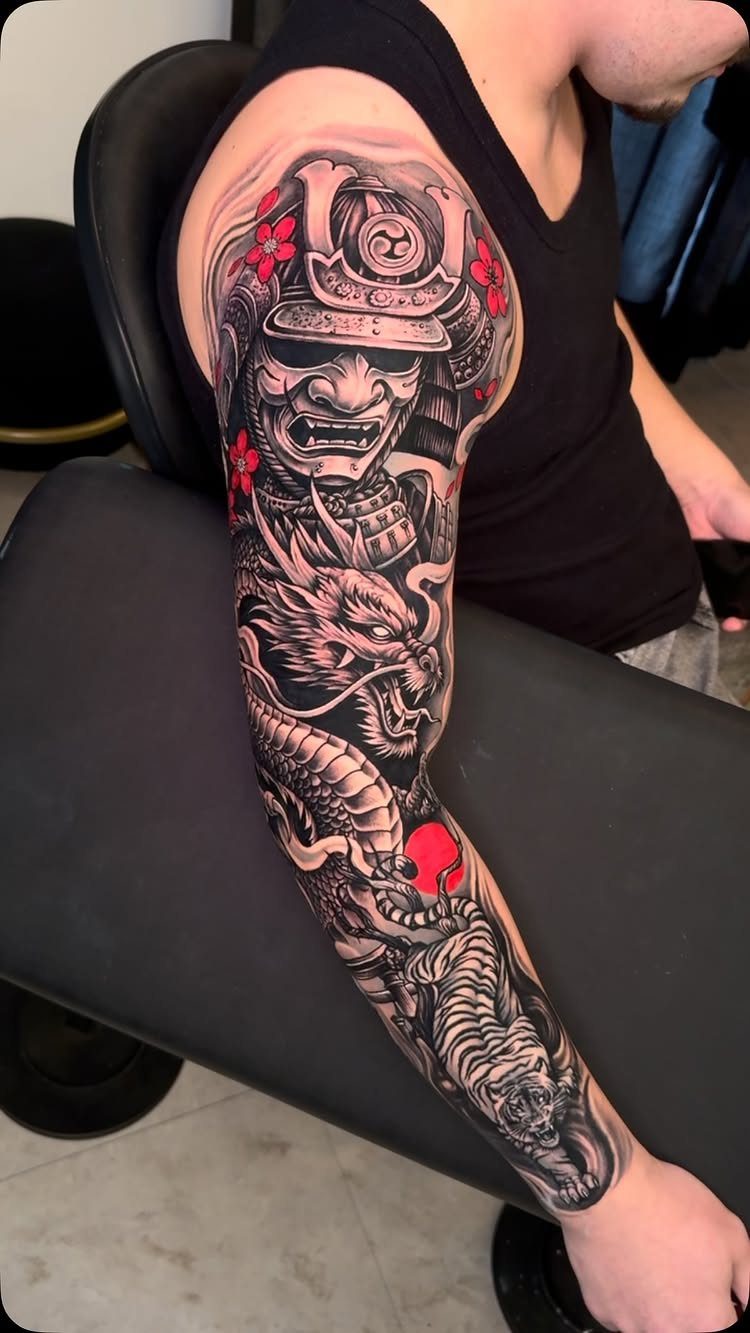
Samurai and dragon pairings carry the tension between human discipline and natural force.
The helmet, with its crest and neck guard, gives the artist hard geometric shapes to set against the dragon’s curves; red accents on both tie them into one composition.
A sleeve this dense with 2 major figures needs hierarchy.
The samurai helmet reads as foreground, the dragon as atmosphere or threat behind, or the reverse; mixing the planes creates confusion. Decide which dominates before the first session.
The color is limited, used as punctuation rather than field, which keeps the piece readable at distance and ages cleaner than full color saturation.
18. Dragon with Oni Mask Tattoo
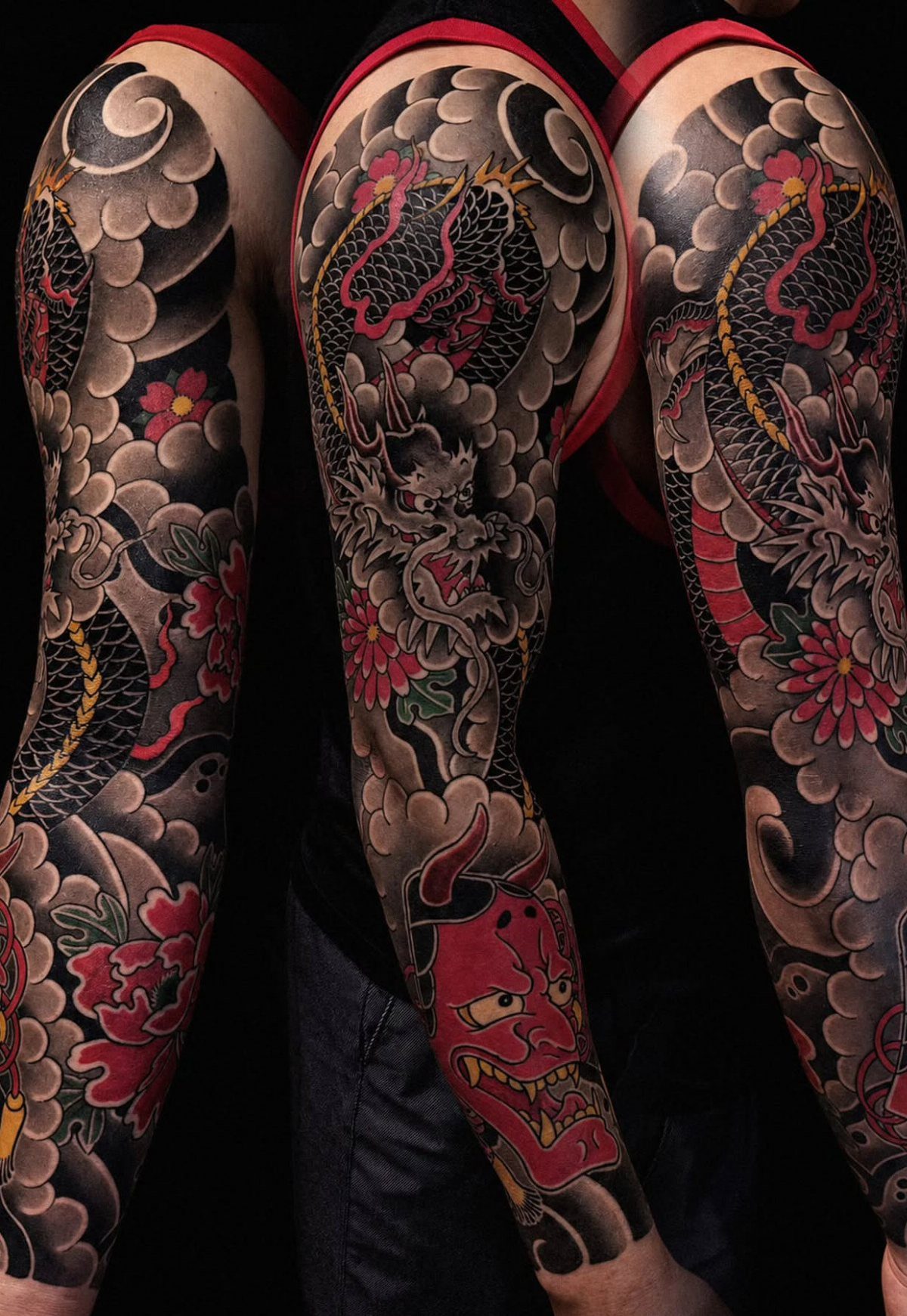
Oni masks and dragons share protective territory in Japanese tattooing, but they guard differently.
The dragon stands for wisdom and direction; the oni mask turns harm away. Pairing them on a sleeve creates two guardians with distinct jobs, the mask at one focal point, the dragon’s body threading through.
Red on the mask against black dragon and grey clouds follows a limited palette that holds up over time.
The mask’s red will soften faster than the black, plan for that; the design should read even when the red has dulled to rust.
Wind clouds separate the elements and keep the arm from feeling segmented. A sleeve this full needs the background to carry motion, or the figures sit like stickers rather than living on the skin.
19. Dragon and Pagoda Tattoo
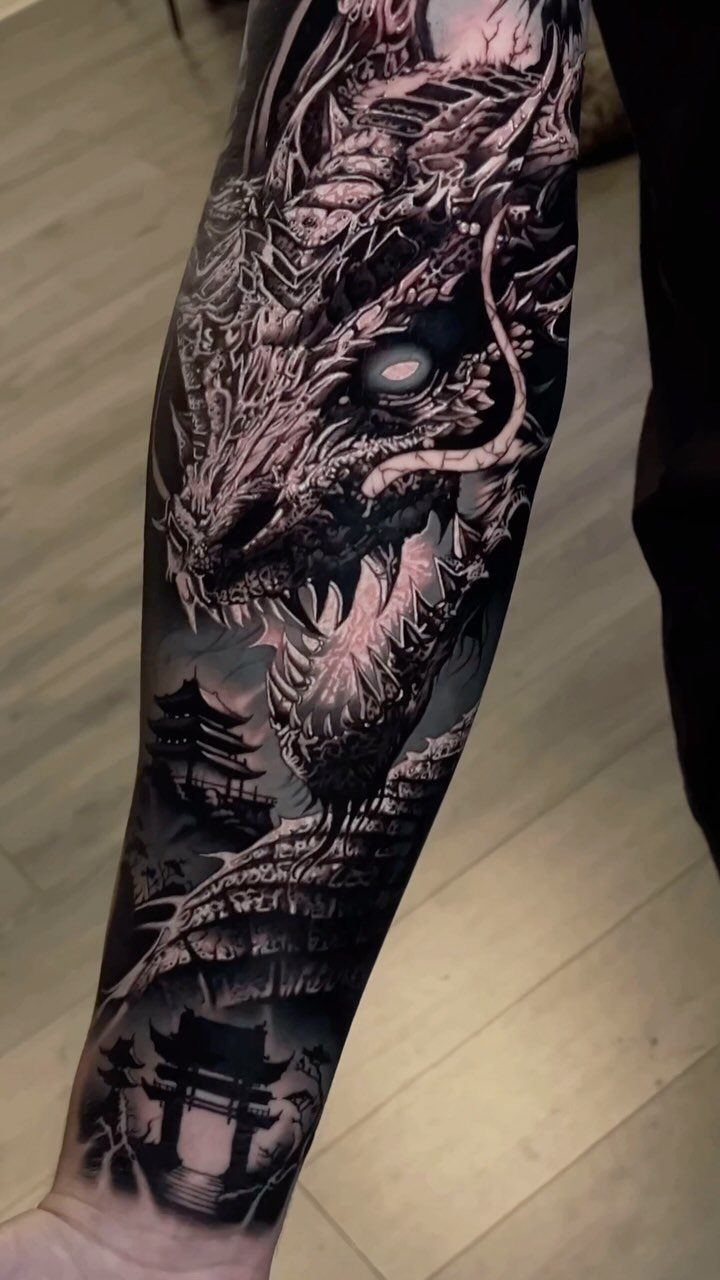
A pagoda gives the dragon somewhere to live, not just something to coil around. The tiered roof lines repeat the dragon’s own ridges, so the architecture and creature read as one system rather than figure and background.
Forearm placement like this keeps the pagoda upright and readable; the dragon’s head can emerge from behind or descend toward the wrist. Torii gate silhouettes at the edges frame the scene without demanding detail that would blur at this scale.
Black and grey suits the stone-and-ink mood of temple architecture.
Color would shift the focus to the dragon alone. Ask your artist which roof angles will hold their geometry once healed; the fine ridges are the first thing time softens.
Cultural Significance of Dragons
The Japanese dragon carries a different temperament than the western one. Where European dragons hoard and threaten, the Ryū brings rain, guards temples, and stands for wisdom earned through age.
Water is its element, not fire; the association runs through centuries of folklore where dragons controlled rivers and weather, the forces that fed or ruined crops.
Color sharpens the meaning further. A red dragon reads as fierce protector, green ties to nature and growth, black signals accumulated wisdom, blue carries forgiveness and guards the eastern quarter.
Gold layers in prosperity and virtue. The color is not decoration; it is the dragon’s character made visible.
None of this is fixed tattoo law.
Artists adapt tradition, and personal meaning overrides inherited symbolism. But knowing what the old stories assigned helps you choose with intention rather than picking a palette because it photographs well.
Traditional Tattooing Methods
Irezumi literally means inserting ink, and the term covers both the art and the method.
Tebori moves slower than a rotary or coil machine. The artist works rows of needles by hand, building saturation through repeated passes rather than continuous motion.
Pain is different, more diffuse and longer in duration per session. Healing tends to be less traumatic; the skin takes less blunt trauma without the machine’s speed and vibration.
Finding an artist who works Tebori in the US is harder than finding one who renders Japanese style with a machine. The commitment is longer, the cost higher, the artist pool smaller.
Some collectors fly to Japan specifically for this. Others find a machine artist whose Japanese work is respectful and technically sound, which is the more practical path for most.
Choosing Colors and Placement
Placement should follow the dragon’s movement, not just where you have empty skin.
A spiral that climbs reads naturally on a forearm, head toward wrist. A full-bodied wrap needs the full arm to tell its story without cramming.
The back and chest offer the most uninterrupted canvas; arms trade space for visibility.
Ribs and hip carry the dragon well but cost more in sessions and discomfort. Where skin stretches or flexes constantly, stomach and inner bicep, the design needs extra planning so it does not distort.
Color choice maps to meaning but also to longevity.
Deep indigo, red, green each carry traditional character associations. No pigment holds up like black and grey; color work means planning for touch-ups down the road.
On areas that see sun regularly, forearms especially, that gap widens faster. Plan the palette with your artist’s healed work in front of you, not just their fresh portfolio.
Frequently Asked Questions
What does a Japanese dragon tattoo mean?
Strength, wisdom, protection, and transformation are the core meanings.
Ryū, the Japanese dragon, brings water and rain rather than flame; the meaning is protection and balance, not destruction. Color adds another layer: blue guards the east and spring, black signals experience, gold marks wealth.
Why do Yakuza have dragon tattoos?
Dragon tattoos in Yakuza culture mark loyalty to the organization and personal dedication to its hierarchy.
The dragon’s traditional association with wisdom and power fits how members see themselves or wish to be seen. Irezumi of this scale also demonstrated endurance, since full pieces required years of painful sessions.
Should a dragon tattoo face up or down?
Direction depends on placement and the motion you want. An upward spiral suits a forearm, head toward the wrist, giving the dragon lift as your arm moves.
A full sleeve or back piece lets the body wind with your own muscle flow, so the head’s direction follows the composition rather than a fixed rule.
Map this with your artist before any linework; the dragon’s path should read clearly both at your side and in motion.
What anime character has a dragon tattoo?
Kaido from One Piece carries a dragon form that translates directly to tattoo work, and Shenron from Dragon Ball remains a common request.
A Dragon Ball sleeve or a Spirited Away back piece still lands because the art style itself became iconic; lesser-known series can drop out of memory, so mixing the character with waves, cherry blossoms, or classic scales keeps the tattoo readable even if the show does not.