Hand tattoos for guys run from a single triangle that takes minutes and costs next to nothing, to full-hand blackwork snakes or Japanese dragons that demand multiple sessions and serious chair time.
A watch band or ring can hide a small piece, but a skull across the knuckles or a dragon to the wrist turns every handshake into something people remember.
The swelling after a detailed top-of-hand piece makes closing your fist genuinely difficult for several days, which is the kind of healing reality that shapes the decision before you ever pick a design.
[link-whisper-related-posts]1. Top of Hand Tattoos
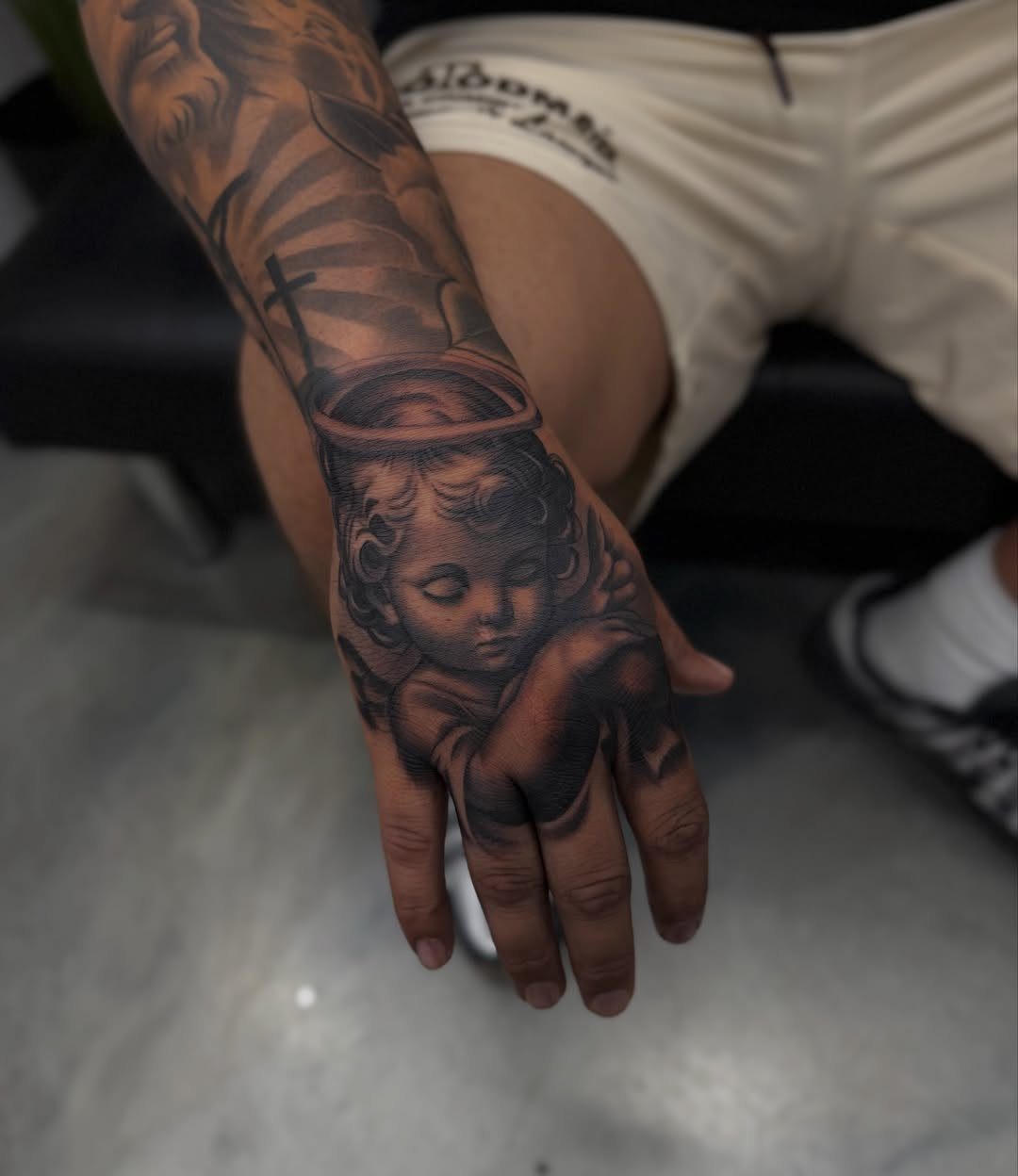
The top of your hand gives a tattoo room to breathe. A design here spreads across the bones and tendons, visible every time you reach for something or shake hands.
That visibility cuts both ways: it reads clearly from across a room, but it also means no long sleeves can hide it for a job interview.
A cherub and cloud scene works on the top of the hand because the shape of it frames the image naturally.
The knuckles act as a bottom border, the wrist as an exit point into a sleeve. If you already have forearm work, this placement ties the story together rather than leaving the hand as blank negative space.
Pain runs higher here than on fleshier spots.
The skin sits thin over bone, and the needles tap directly against the extensor tendons. Most artists quote 2 to 3 hours for a detailed top-of-hand piece, sometimes split across sessions to let the swelling settle.
Plan for a longer healing window too: you use your hands constantly, and keeping a fresh tattoo clean while you wash dishes, type, or open doors takes real attention.
You trade permanence for visibility in the most public place you own. For some guys that is exactly the point.

What's included: 1 Set = 9 sheets henna tattoo stencils, template size: 21 cm x 12 cm/8.2" x 4.7" (Only Templates,No Tattoo Ink); Paste location: hand, finger, forearm, legs and other parts of the body

COMPLETE KIT: Set includes 18 sheets of self-adhesive henna stencils featuring traditional Indian Mehndi designs for hands and body art
2. Knuckle Tattoos
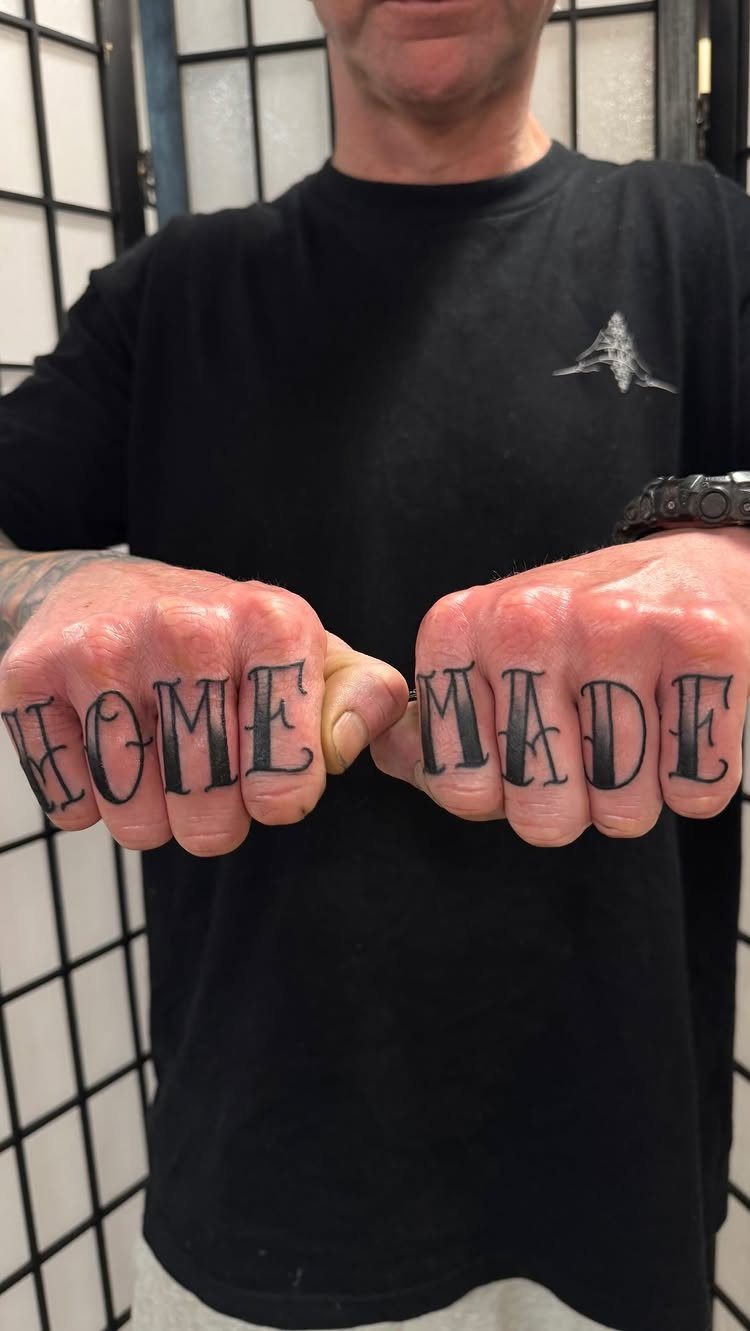
Knuckle tattoos carry weight that other placements do not. Small surfaces across both hands have spelled out everything from "HOLD FAST" to "STAY TRUE" since sailors first marked themselves for luck at sea.
The letters in "HOME MADE" sit one per finger, the spacing forced by bone width, the word broken by necessity.
Each knuckle becomes its own frame. Gothic lettering fits because the vertical strokes fill the narrow space; symbols work when they read at glance-size.
The composition either runs straight across both hands or mirrors, one hand completing what the other starts. Either way, the viewer reads it fist-first, which changes the tone of whatever word you choose.
Fading hits fast here.
The skin stretches and flexes thousands of times daily, and sun exposure is constant unless you glove up. Most artists recommend bold black ink over fine lines, and touch-ups every few years are almost guaranteed.
The commitment is less about the pain, though that is real, and more about accepting that this tattoo will always announce itself before you do.

High-Fidelity Hand Model for Realistic Tattoo Practice This silicone hand model replicates an adult Women left hand with anatomical accuracy, capturing detailed skin texture, knuckle definition, and lifelike contours. The practice hand offers a true-to-life training surface for hand tattoos, allowing artists to perfect techniques on curved fingers and bony prominences. Whether practicing basic hand tattoo designs or complex hand tattoos artwork, this hand model provides the most realistic tattoo practice experience outside of human skin

🦋Note: Shake the ink thoroughly prior to use.

3. Single Finger Tattoos
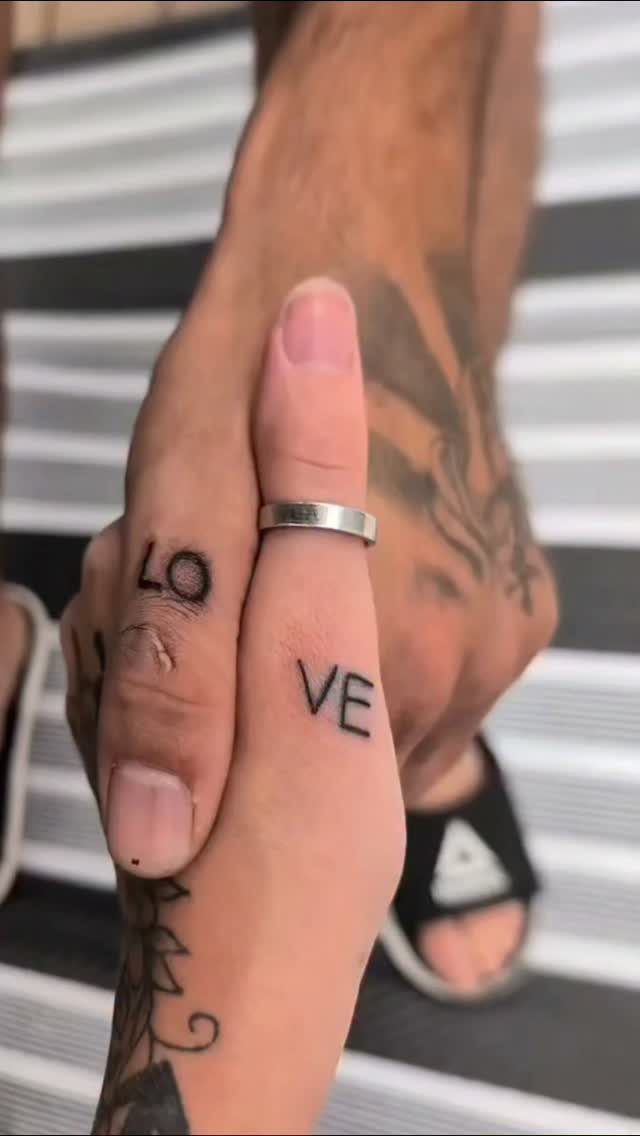
Single finger tattoos let you test drive permanence. Splitting a word across two hands turns them into one message, but the same logic works for a single symbol, a date, or a band of pattern wrapping one digit.
The skin here is thin, the bone close beneath, and the surface small enough that a mistake has nowhere to hide.
A finger piece heals differently than almost anywhere else. The constant motion of flexing and gripping sheds ink; the sides of the finger rub against pockets and keys.
Finger tattoos soften to a grey blur without touch-ups; the skin there sheds fast and the ink takes a beating. Some artists warn clients outright that they will not guarantee the work.
That said, the low stakes matter. A finger tattoo costs less than a full hand piece, heals faster in surface area, and can be covered by a ring if you need.
For guys unsure about hand tattoos generally, one finger is a way to learn how their skin holds ink, how their employer reacts, how they feel seeing it daily.
If it fades or you outgrow it, the space is small enough to rework into something else.
The ring finger and middle finger hold ink best; the pointer and pinky flex most and fade fastest. Ask your artist about placement before settling on which digit gets the design.

Crystal Clear Transfer & Stable Stencil Effect : Our KVM transparent tattoo stencil film delivers sharp, clean printed lines. The pattern transfers perfectly onto skin, not easy to smudge or wipe off after application. It works great for intricate mandalas, skulls, portraits and line art.
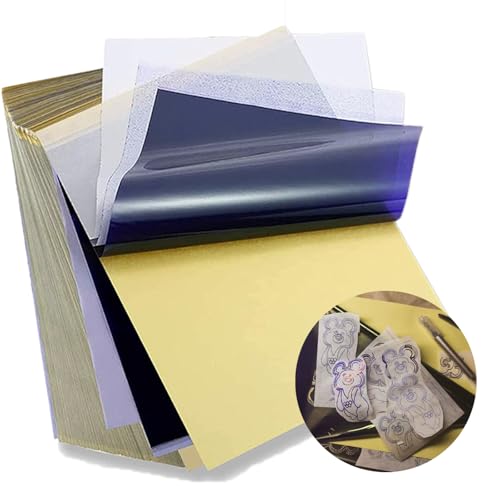
Standard size: Tattoo Transfer Paper is standard A4 paper size, each measures 8.27 in X 11.69 in. There are 4 levels in total. The thickness of the paper is very light and smooth to the touch.
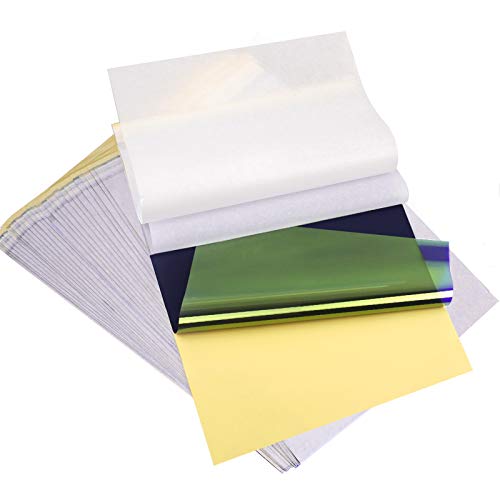
ADVANCED MATERIAL: Tattoo transfer paper is made with the high quality dyes and stencil paper. Transfer marks are very clear, clean and smooth. Tattoo transfer paper kit come with 35 sheets. Great for tattooing, trace and transfer images onto the body.<br>
4. Skull Hand Tattoo
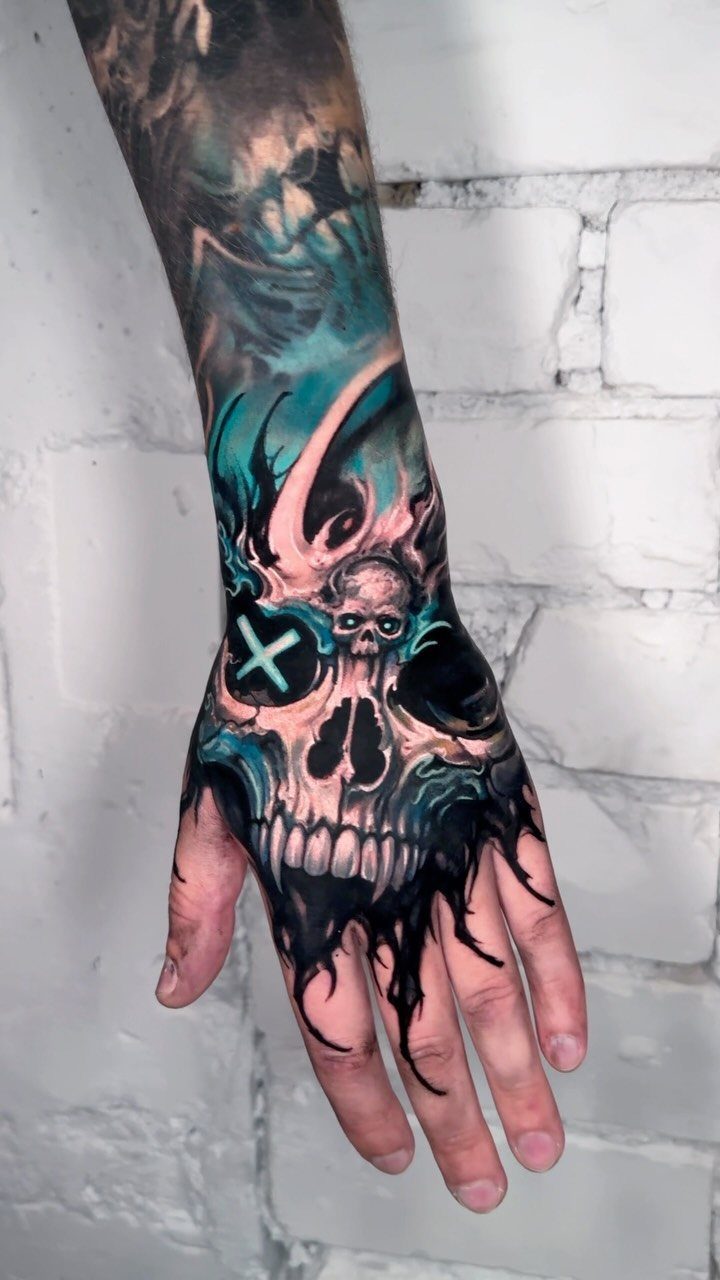
A skull on the hand makes mortality impossible to ignore. Teal against black and grey draws the eye to jaw and temple details that would otherwise sink into shadow.
That choice matters because a hand skull needs to read instantly; the viewer will not study it like they might a back piece.
The meaning is blunt in a way other tattoos avoid. Death sits right there when you hand someone coffee, sign a document, or rest your arm on a bar.
Some guys choose this after a close call, a loss, or simply arriving at an age where the end feels real rather than abstract.
The skull does not say you welcome death; it says you have stopped pretending it will not come.
Detail work here requires an artist comfortable with hand anatomy. The metacarpals create ridges that distort flat designs; a good piece flows with those ridges rather than fighting them.
Color holds up if you commit to sun protection, but black and grey ages more forgivingly on hands that spend time outdoors.
Dense skull work on the hand takes serious chair time, and the swelling afterward makes closing your fist genuinely difficult for several days.

COMPLETE AFTERCARE KIT FOR NEW & EXISTING TATTOOS: This Tattoo Aftercare Kit brings together 3 essentials, Antimicrobial Soap, Tattoo Balm, and Tattoo Lotion, to help cleanse, protect, and moisturize fresh ink. Useful after tattoo sessions and throughout healing, it supports vibrant color and skin comfort for dedicated ink enthusiasts and artists


Nourishes Healing Ink for Vibrant Color: Tattoo Goo supports healing tattoos & maintains vibrancy on healed ink with a lightweight formula rich in olive oil, lavender oil, cocoa butter, and beeswax. It absorbs quickly, moisturizes deeply, and helps reduce dryness, itch and tightness so your tattoo looks and feels comfortable through everyday routines
5. Rose Tattoo on Hand
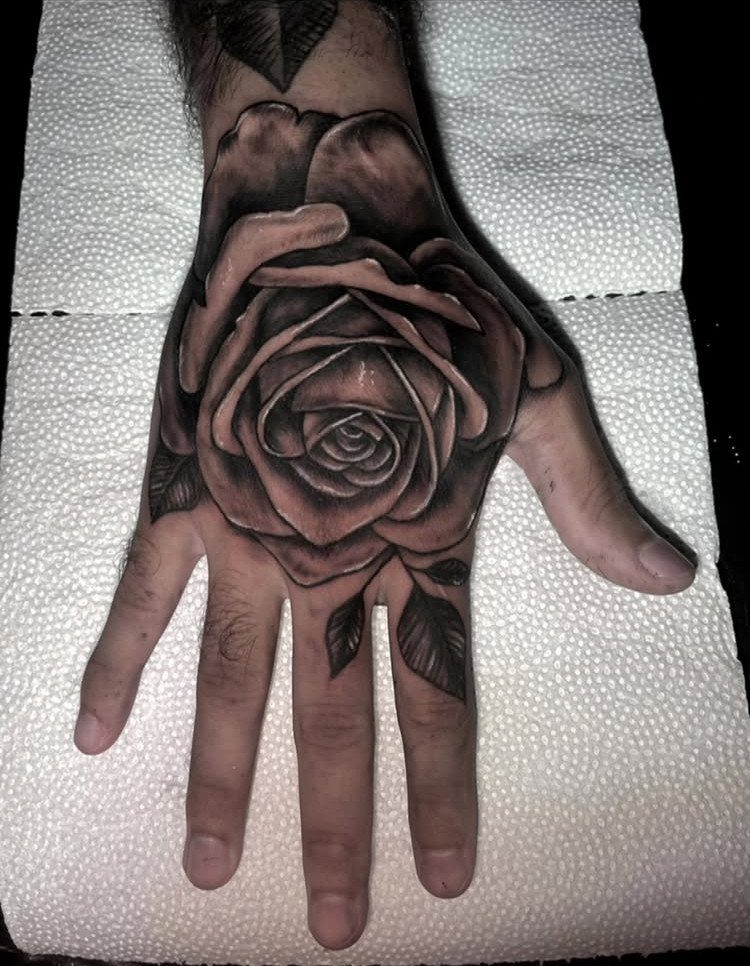
Roses carry weight that outlasts most flower symbolism. On the hand, a single large bloom speaks to something specific: a person, a moment, or the idea of devotion itself.
Shading that runs deep enough lets petals fold visibly, the black and grey avoiding the cartoon flatness that cheaper work falls into.
Hand placement changes the rose from decoration to declaration. A chest rose is private; a hand rose is shown, offered, extended.
Guys who choose this often pair it with a name or date elsewhere, or let the flower stand alone as the bond itself. The meaning does not need explaining, which is part of the appeal.
The size matters practically. A small rose on the hand would blur as the skin ages; this coverage uses the full canvas from wrist to knuckle, giving the artist room for detail that lasts.
The knuckles interrupt the design, so most artists either work around them with leaves or stems, or extend the bloom large enough that the fingers become part of the composition rather than breaks in it.
Healing means keeping the hand elevated when possible, since gravity pools fluid in the fingers. Swelling can last a week, and the temptation to pick at peeling skin is constant when you see it every moment of the day.

Product Including: you will receive 3 pairs of fingerless gloves for thin skin in total, approx 19 inches in length which can effectively keep sensitive and thin skin from tears, bruises and abrasions, while providing a comfortable wearing experience

Cooling & Comfort: The cooling arm sleeves are make of sweat-wicking fabric, which is breathable, dries fast, keeping your arms cool even in extreme heat.

Texture of material: 70% nylon, 30% spandex (1 pcs)
6. Joker Hand Tattoo
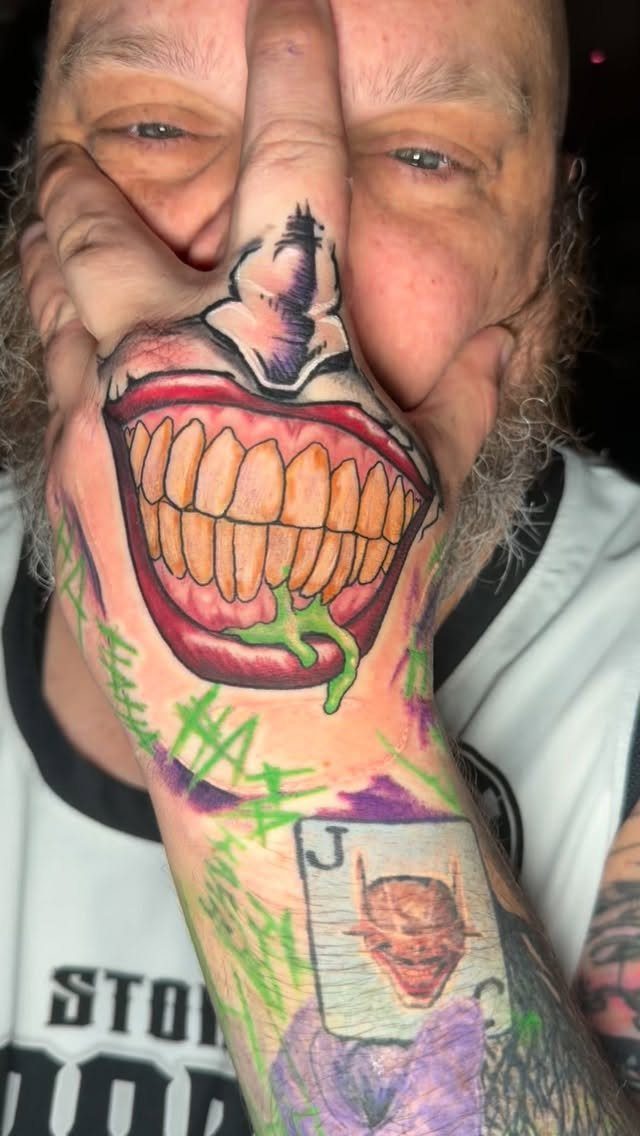
The Joker works on a hand because the character himself performs with his hands: the card flourish, the gun barrel flower, the smeared makeup grabbed in desperation.
The mouth works as a central image, the grin wrapping from wrist toward the fingers, green dripping below like a spill the wearer cannot wipe away. That placement turns the whole hand into the performance.
Comic accuracy is not required.
Some guys go Nicholson, some Ledger, some the animated series or their own hybrid. Quotes work too, though lettering at hand scale needs to be thick enough to survive the first year of fading.
A playing card adds context without demanding more skin; a single card corner peeking from the wrist ties the image to the character’s origin without overloading the space.
This design suits guys who already move through spaces where visible tattoos draw no second glance. The Joker carries chaos as part of his identity, and a hand tattoo of him signals that you accept some of that association.
Color saturation matters: the green and red need to stay bright or the face becomes muddy. Budget for touch-ups, and choose an artist who has done comic portraits before, since cartoon features distort easily when translated to skin.
The healing period will look ironic. A swollen hand wearing a fresh Joker grin is indistinguishable from the character’s own battered state, which some wearers find fitting and others simply endure.

1 Set = 12 Sheets Henna Tattoo Stencils, 6 Pairs Right and Left hands stencils. Pasting position: Hand, Finger,Forearm, etc. Suitable for Henna tattoo, Airbrush Painting, Glitter tattoo, and so on;

RICH TEMPORARY TATTOO KIT - Contains rich tattoos pattern templates (126 designs),6 tattoo inks in 2 colors (black and brown),4 disposable gloves 1 pack of cleaning supplies,allowing you to easily create unique personalized tattoos
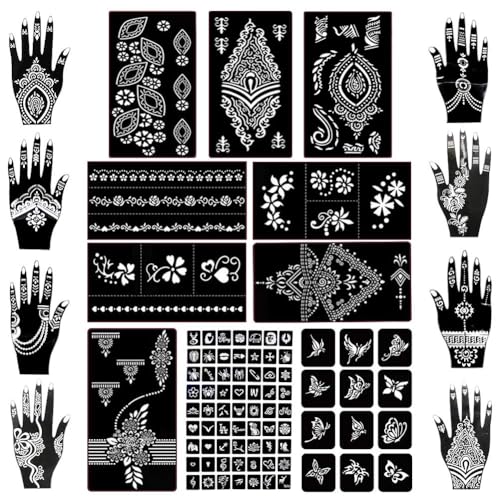
97 HENNA TATTOO DESIGNS IN 18 SHEETS:Includes 8 hand stencils, 8 rectangle flower pattern sheets, and 2 small pattern sheets. Features butterflies, flowers, roses, mandalas, paisley, and traditional Indian/Arabian mehndi designs. Perfect for creating stunning body art for weddings, festivals, and summer celebrations.
7. Spider Hand Tattoo
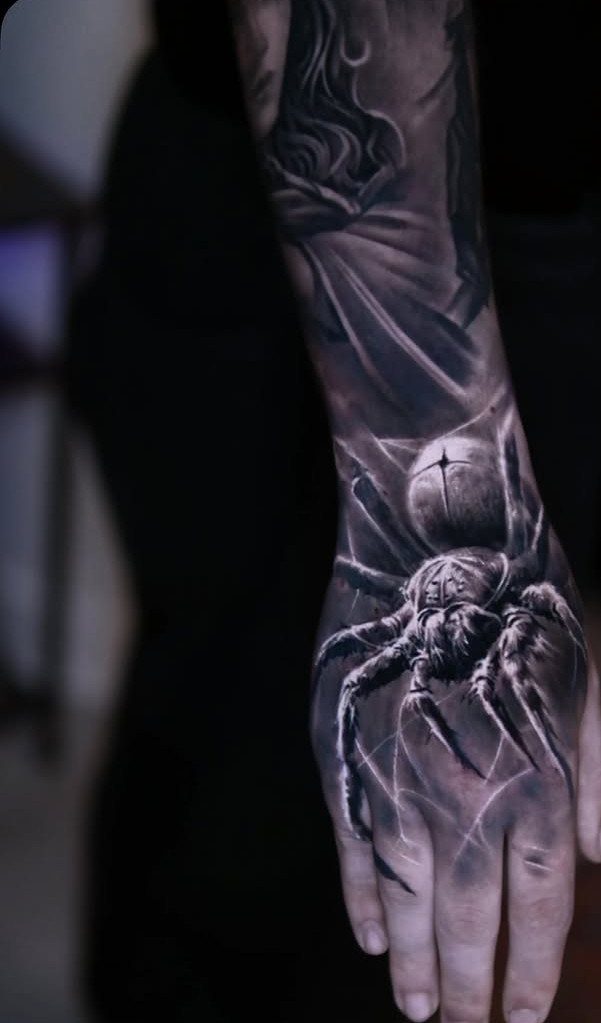
A spider on the hand turns the whole limb into a web.
The creature sits at the center of what you reach toward, the legs extending across tendons that move with every gesture. That placement matters symbolically: the spider builds rather than waits, and the hand becomes the tool of that building.
Black and grey realism suits this idea because the shading gives the abdomen weight and the legs dimension against the flat plane of skin.
A web that trails onto the forearm connects the hand to larger work and keeps the spider from looking stranded.
The web itself needs careful planning; straight lines that cross the knuckles will warp as fingers bend, so most artists curve the pattern to follow natural creases.
The meaning is personal without being obscure.
Control over circumstance is a private commitment made visible, and the hand placement means you see it during every task that frustrates you. That reminder is the point.

PACKAGE AND SIZES - 20pcs individual packaging for each tattoo practice skin. The thickness of these silicone pads is 0.04in (1.0mm), measures 7.4" long by 5.6" wide. Providing enough space for your masterpiece creation. Both sides of each tattoo skin are blank, can be used on both sides.

This tattoo kit have two Dragonhawk tattoo machines for lining & shading and friendly beginner start tattooing life, Cast iron tattoo machine 10 wrap coils. Made of superior composite material, the spring is high-elastic and anti-fatigue for long-time working, made of copper coils.

Disposable Blackout Tattoo Tube and Grip Sets 49 Flat Grips size 1.25" Single use Gas Sterilized Perfect for heavy blackwork and blackout tattoos
8. Lion Tattoo on Hand
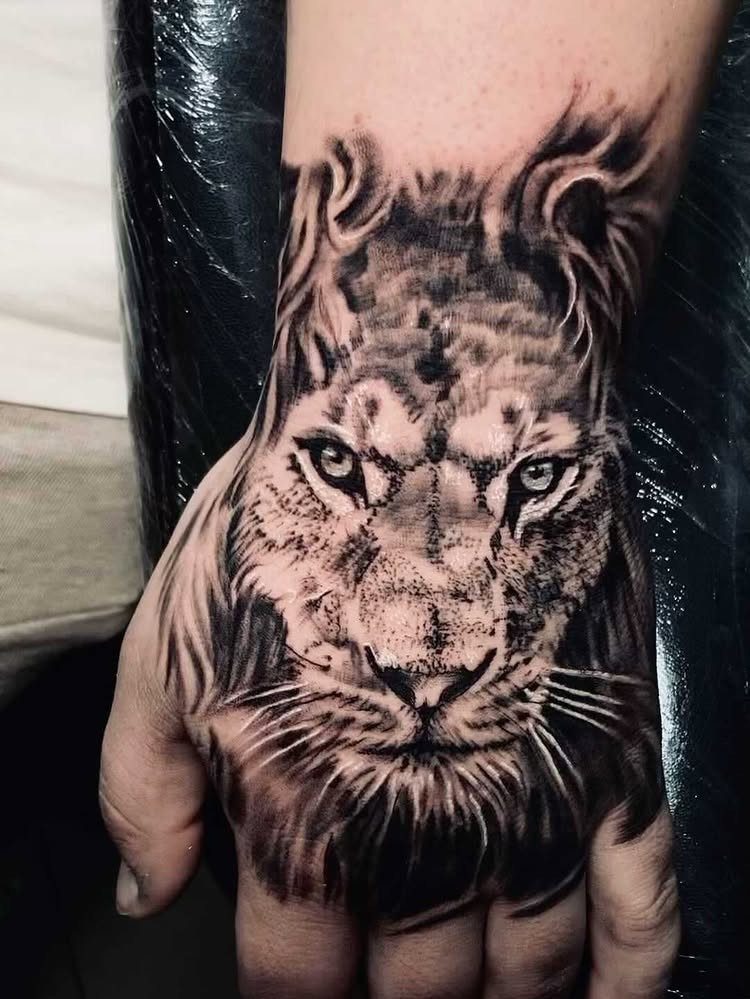
The lion’s face on a hand reads as self-portrait whether you intend it or not.
The mane fills the available space from wrist to knuckle, the eyes level with your own when you look down at your work. That confrontation is built into the placement.
Black and grey shading keeps the expression serious; color would tip toward cartoon or sports-team territory.
The muzzle must align with the hand’s center line or the whole face skews when viewed straight on, a technical challenge that separates experienced portrait artists from those who should decline the job.
The nose typically sits over the third metacarpal, the eyes between knuckles, using bone structure as armature rather than fighting it.
Guys choose this after proving something to themselves, not to announce strength they doubt. The lion does not perform for observers; it faces the wearer, which changes whose approval the tattoo seeks.

Warm Tips: The tattoo transfer paper need to work with transfer medias.You will need to purchase the stencil ointment separately. Apply the design made on the master paper. Please pay attention to press the back side of the pattern to the skin for at least 3 seconds

Premium Quality Thermal Paper: 100 continuous feet of Thermal Paper ensures uninterrupted tattoo stencil creation. Cut to any desired length, maximizing efficiency and minimizing waste.

Precision Transfer Performance - It’s professional-grade tattoo stencil paper delivers vibrant, high-definition transfers even for intricate designs. The carbon layer ensures sharp outlines without smudging or fading, ensuring crisp lines that stay true to your original artwork.
9. Minimalist Triangle
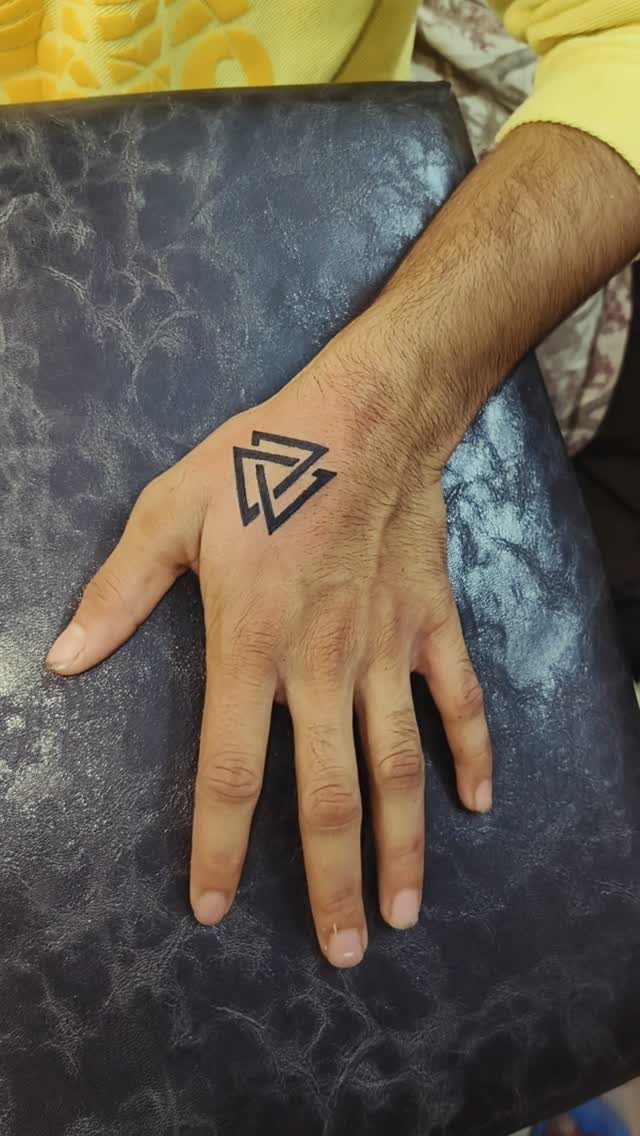
Small geometry on the hand tests how little ink still registers as intention.
A single interlocking triangle, or two overlapping, sits on the back of the hand where the skin is flatter and the bone less prominent than over the knuckles. The design reads as deliberate precisely because it avoids the obvious spots.
This suits first-timers who want hand visibility without hand commitment.
The tattoo takes minutes, costs accordingly, and heals faster than any piece with shading. The risk is minimal too: a blown line on a triangle is easy to thicken or extend into a larger shape later.
Employers who object to visible ink will still notice it at conversation distance, since a normal watch band worn at the wrist sits well below this spot.
The style demands precision that looks effortless. A wobble that would hide in a busy design stands out here, so choose an artist with geometric work in their portfolio rather than one who specializes in organic forms.
Black ink only; color would contradict the restraint that makes the idea work.

🌿 VIBRANT COLOR & DEEP MOISTURE - Crafted with nutrient-rich a&d ointment, our balm deeply hydrates freshly inked skin. It supports your natural moisture barrier, keeping body art and microblading looking bold and beautifully vibrant.
Honest, Accurate Care – This protective ointment comes in 50 hygienic single-serve packets for mess-free, on-the-go convenience. Easy to apply for tattoo protection anytime.

UNIVERSAL CREAM APPLICATOR: Designed for virtually any topical product — diaper rash cream, sunscreen, muscle rub, chamois cream, tattoo aftercare balm, nipple cream, and more. Fill the silicone tube with your favorite lotion or ointment and apply hands-free with zero mess.
10. Geometric Mandala
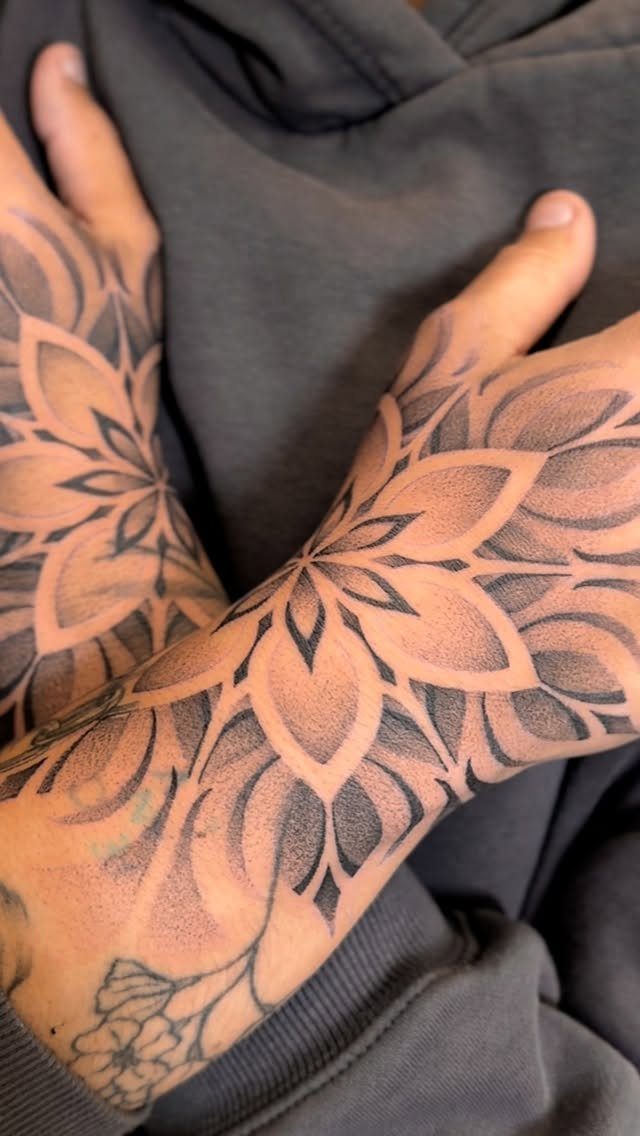
Symmetry on both hands turns the body into a matched set.
The mandala’s radial pattern centers on the back of each hand, the petals extending toward fingers and wrist with mathematical regularity that contrasts with the hand’s natural asymmetry. That tension is the design’s energy.
The precision required is extreme: a line off by an eighth of an inch throws the whole composition, and the artist must tattoo one hand while the other already exists as reference.
Most clients book a single long session for the first hand, heal, then return for the second with the healed result visible to match.
This suits guys drawn to structure as comfort.
The mandala repeats, centers, contains; on the hand, where chaos of use is constant, that order is daily felt rather than merely seen. The trade is visibility for serenity, and the choice says which matters more.

FASHION TREND: Ultraviolet protection, sweat absorption, outdoor cycling, fishing, nightclub hip-hop rock, fashion cool, glove arm, big flower arm. There are several styles and you can match different patterns according to your clothes.

Roxun cooling arm sleeves provide a seamless, snug fit, thanks to the durable blend of 90% nylon and 10% spandex. Forget about constant adjustments or circulation issues

Skin Friendly Material: made from breathable and lightweight fabric, these tattoo sleeves are soft to the touch, resistant to pilling and fading, and feature high elasticity and a fingerless design to ensure a comfortable fit; Please check the size chart in the images before ordering
11. Blackwork Snake
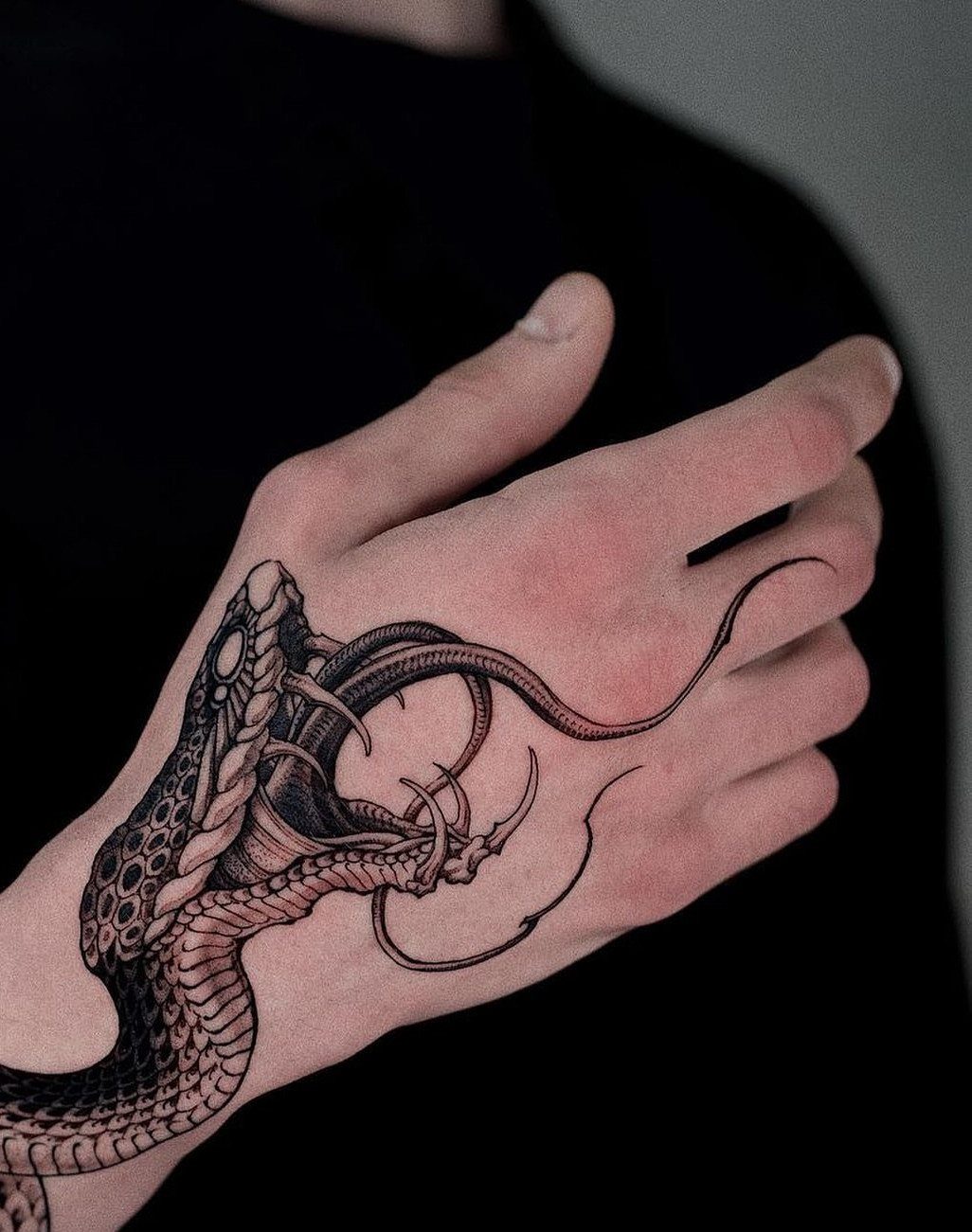
A snake on the hand uses negative space as actively as ink. The body coils around the form, the open mouth advancing toward the fingers as if the hand itself is being consumed.
That movement matters: static snake tattoos read as belts or bracelets, but the striking pose turns the limb into event.
Blackwork density solves a hand-specific problem. The heavy black holds up against sun and friction that would fade greywash to illegibility; the solid forms read even when swollen during healing.
The scales need not be individually drawn at this scale, which would blur together anyway. Instead, texture comes from selective highlight within the black, the belly left lighter to suggest coil and curve.
The shedding symbolism is present without requiring explanation. The snake’s coiled urgency carries meaning privately; guys who have rebuilt themselves after something tend to choose it for reasons they keep to themselves.
12. Japanese Dragon
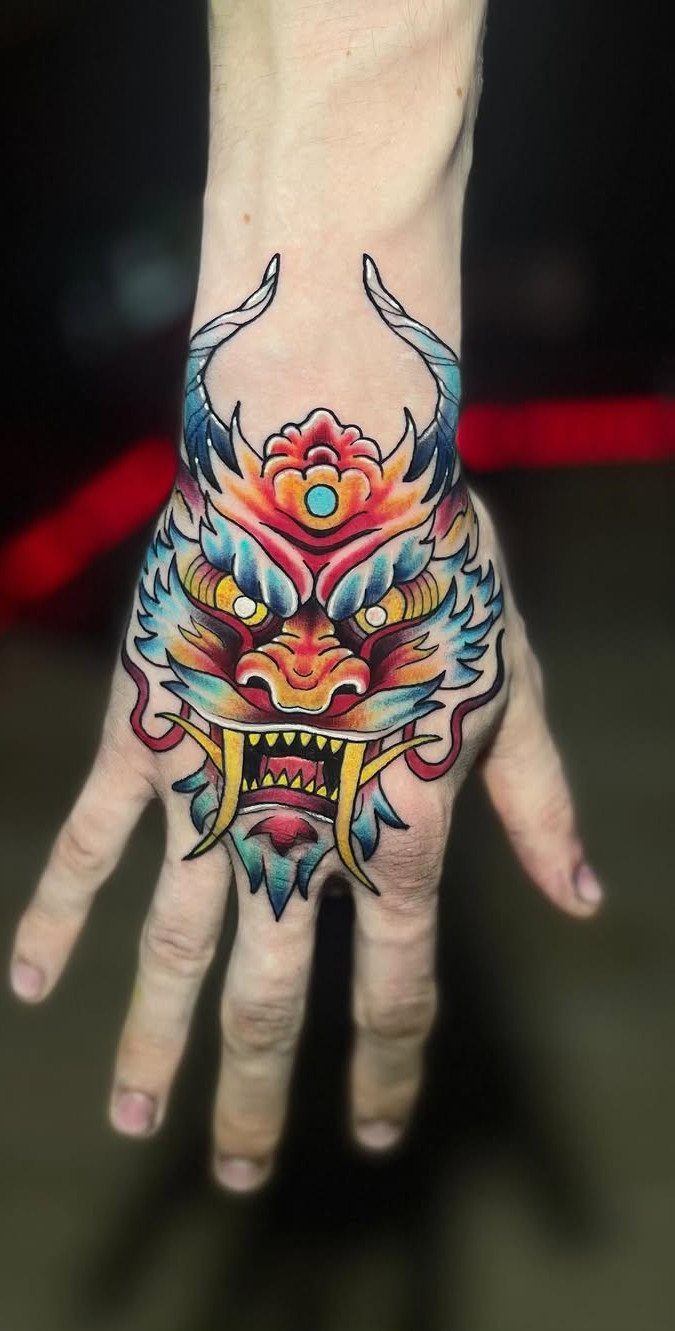
Color on the hand commits fully to visibility.
A traditional irezumi palette of red, blue and yellow against black refuses to hide inside a muted wardrobe. That clash is intentional: Japanese tattooing has always been defiant display, and the hand placement continues that refusal to hide.
The dragon’s horns curve backward to follow the wrist line; the whiskers extend toward the thumb, using the hand’s longest dimension for flow.
Scale patterns must shrink toward the fingers without losing definition, a graduation that takes planning at the stencil stage. Color saturation needs to be heavy; pale irezumi on hands greens out within months.
This suits guys already comfortable with attention.
The dragon carries cultural weight that reads differently across audiences, some seeing tradition and others seeing gangster film reference. That layered reception is part of living with the choice.
13. Dagger Tattoo
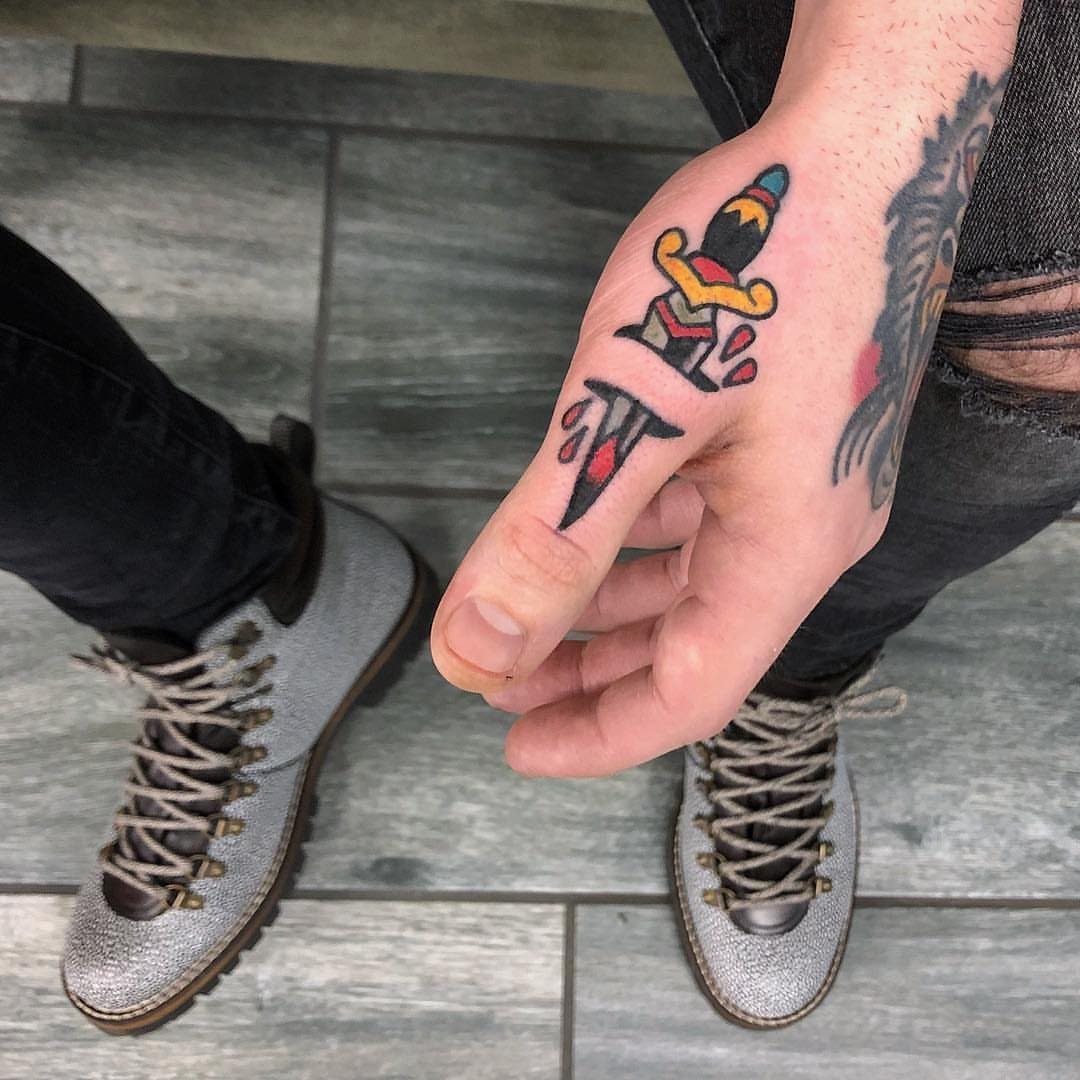
A dagger across the thumb and hand base turns the whole grip into threat or promise. The blade follows the thumb’s long axis, the hilt sitting where the wrist meets the palm, so the hand closes naturally around it.
Color keeps the steel from reading as flat grey; a wrapped leather handle in brown, a ruby pommel, gives the eye somewhere to rest.
A dagger looks sharpest when it pierces something: a rose, a heart, or a banner with a name.
Adding an element later is straightforward: the blade tip extends toward the fingers with room to thread something through. The outer edge placement means the dagger shows in profile when the hand hangs at your side, full length when raised.
This suits guys who want traditional iconography without the bulk of a full hand mask. The vertical format uses space that horizontal designs waste, and the thumb involvement makes it feel held rather than worn.
14. Compass Tattoo
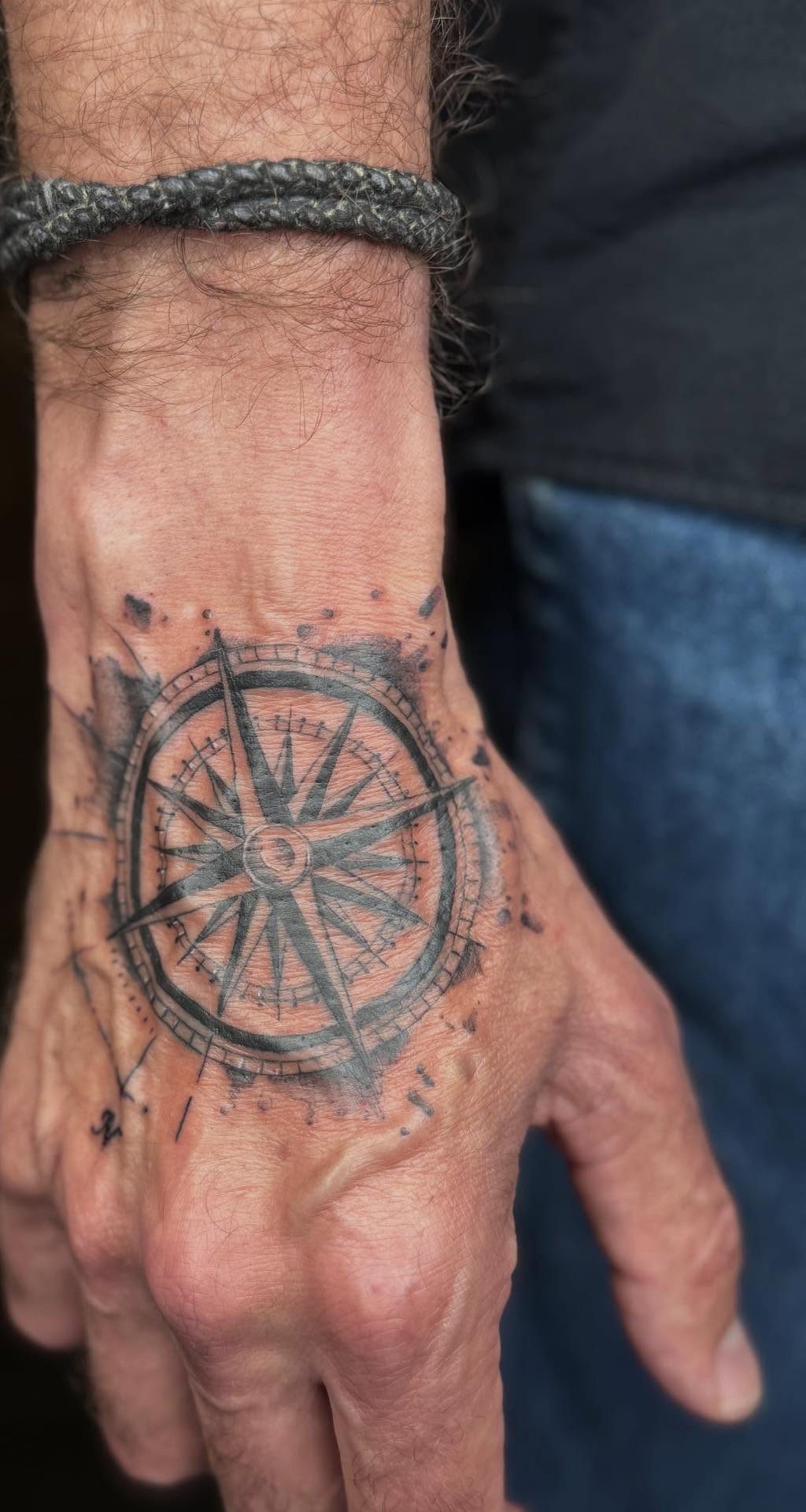
A compass on the hand faces the wearer, not the world.
The north arrow points toward the fingers, the rose spreading across the back where a glance down confirms it. Splash details around the edges soften the geometry without cluttering the read.
Black ink keeps it employable; color would tip toward weekend sailor. A compass sits well beside a leather bracelet or braided band, as long as the materials share a weathered, traveled feel without matching too neatly.
Scale matters: too small and the degree markings blur, too large and the compass overwhelms the hand’s own shape.
Guys who choose this are often at a turn, not a start.
The tattoo acknowledges that direction shifts, that the path teaches more than the map. Healing means the compass will look water-damaged for a week, the plasma pooling in the splash details like actual sea spray.
15. Abstract Patterns
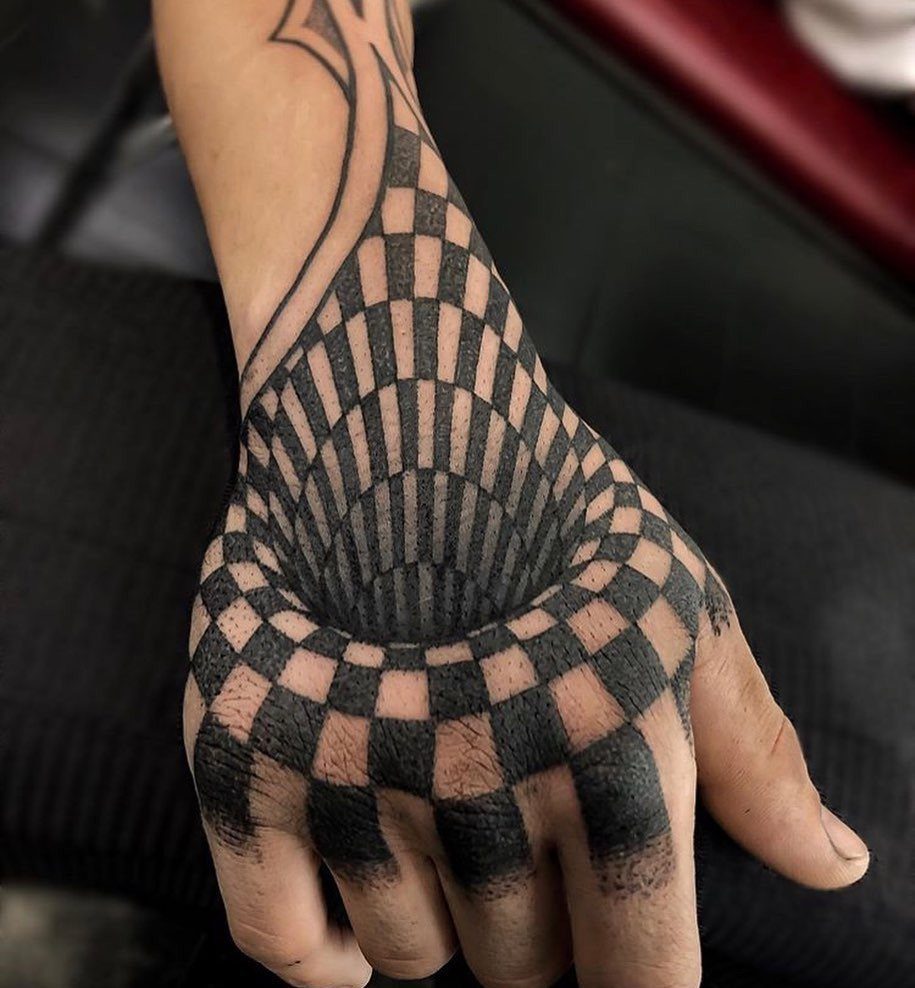
Checkerboard that sinks into the hand breaks the flatness of skin itself.
The vortex centers on the back, the squares shrinking toward a vanishing point that seems to recede into bone, then continues down the fingers and wrist so the illusion does not stop at one plane.
Black and grey only; color would kill the depth.
This demands an artist comfortable with optical work.
The grid must stay mathematically precise across moving joints, which means designing it with fingers bent, then trusting the distortion when straight. The 3D effect works at conversation distance, not nose-close; stepping back completes what stepping forward breaks.
Employability is the trade.
A full-hand pattern this bold does not hide under a watch band or explain away as a small accent. Guys who choose it have already made peace with visibility, or work where the question never arises.
The healing itch is maddening: every square edge seems to lift separately, and the temptation to scratch the center of the vortex is constant.
16. Tribal Hand Tattoo
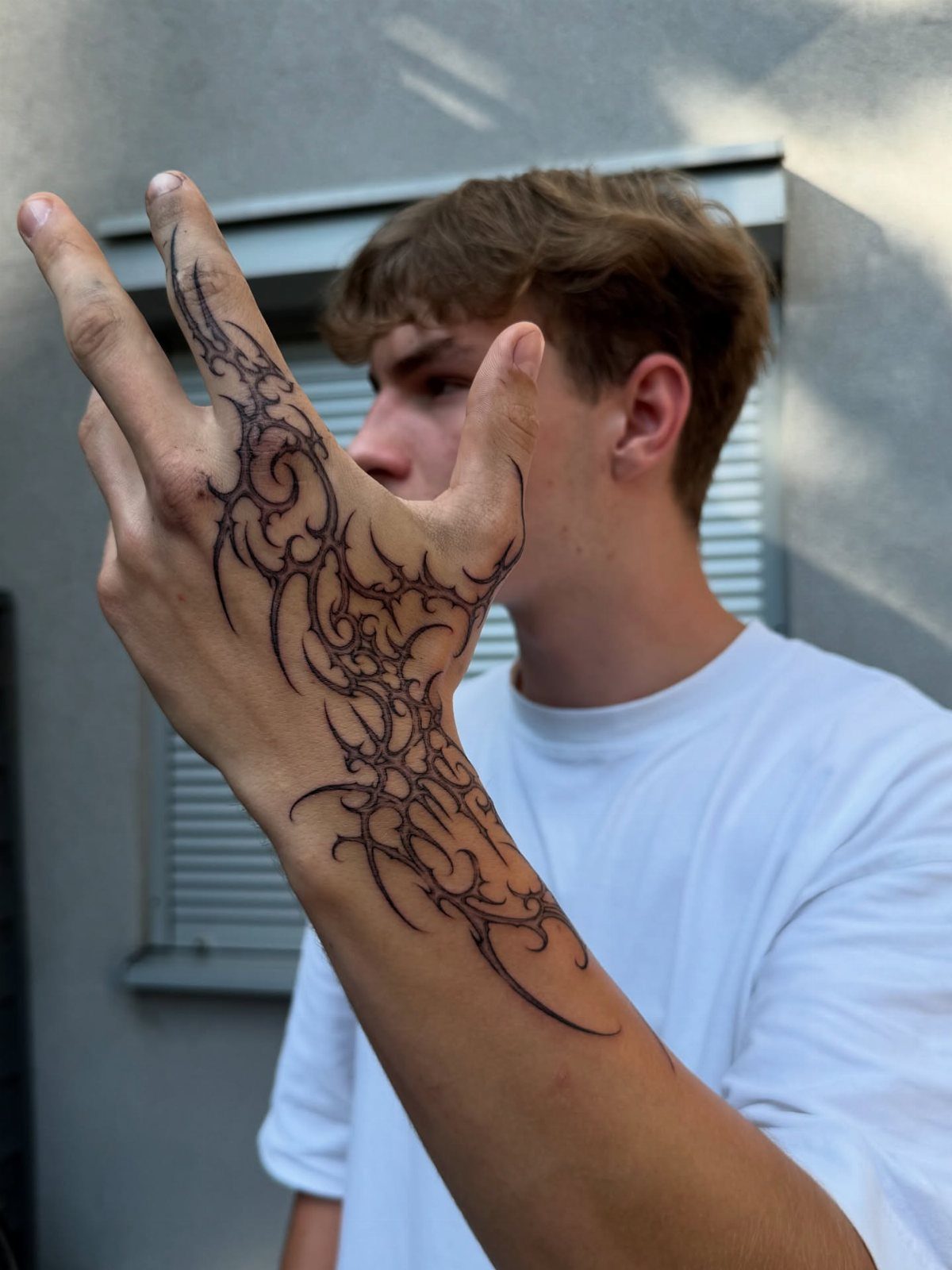
Tribal coverage that reaches the finger turns the hand into a tool of lineage. A tribal hand tattoo that tapers at the finger keeps the design from looking stuffed.
Extension onto the index finger is the commitment.
A hand-back piece ends at the knuckle and hides in a fist; finger involvement means the tattoo shows in every handshake, every gesture, every reach for a door handle. The photo’s wearer has accepted that.
Guys drawn to this often have mixed heritage they want to claim, or none at all and want the gravity of rootedness without the specific story.
The black must be saturated; grey tribal greens out and looks like camouflage. Touch-ups are likely, since finger skin sheds fast and the black needs replenishing to stay authoritative.
17. Clock and Roman Numerals
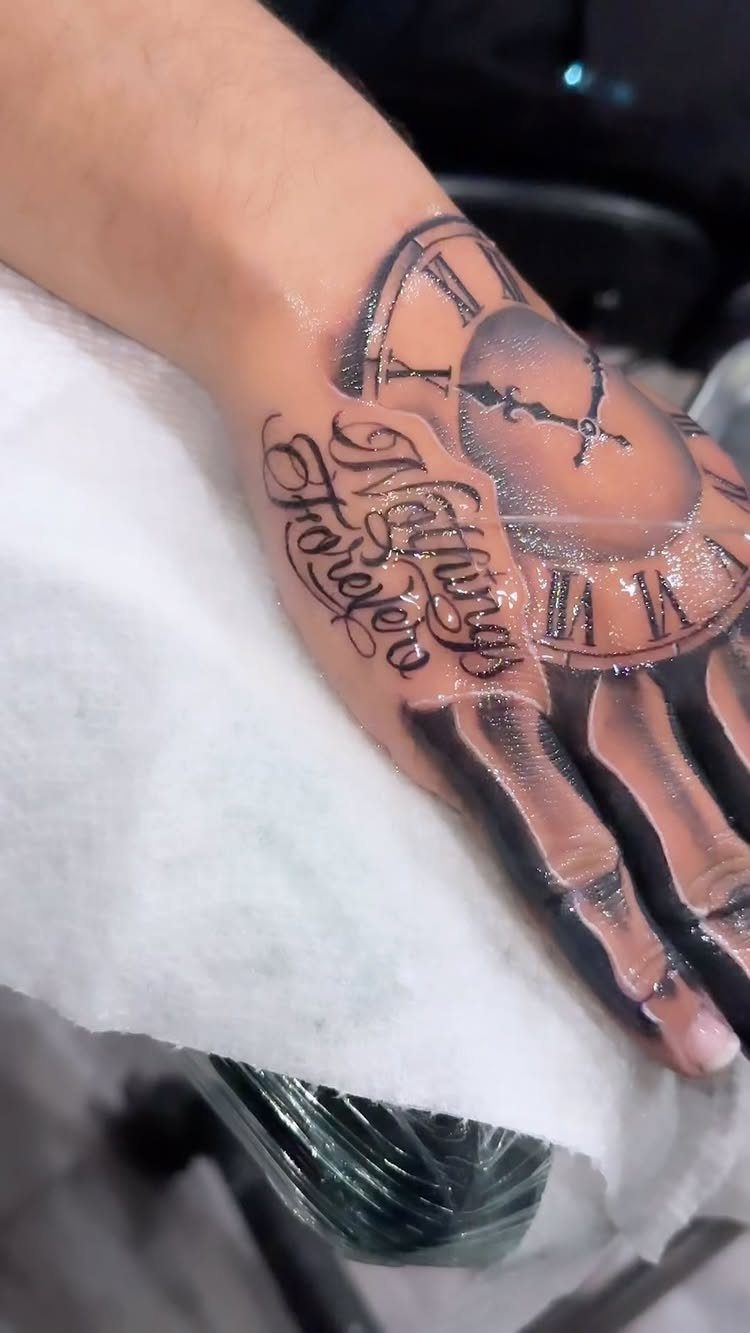
A clock face with Roman numerals and skeletal fingers reads as memento mori the moment you see it.
The script "Nothing’s Forever" runs along the hand’s edge, the words following the natural line from wrist to pinky. That placement keeps the lettering from fighting the clock for center space.
The skeletal fingers in the design echo the bones beneath, a layering that works because the tattoo is fresh and swollen; healed, the effect calms.
Roman numerals demand careful spacing; XII at the top, VI at the bottom, with equal weight around the circle, or the face reads lopsided when the hand moves.
Guys choosing this are marking a specific loss or a general reminder.
The clock time is usually personal, though the photo does not show it clearly enough to read. Setting it to a fixed moment requires deciding before the stencil goes on; changing your mind mid-session wastes skin and trust.
18. Geometric Bone Structure Tattoo
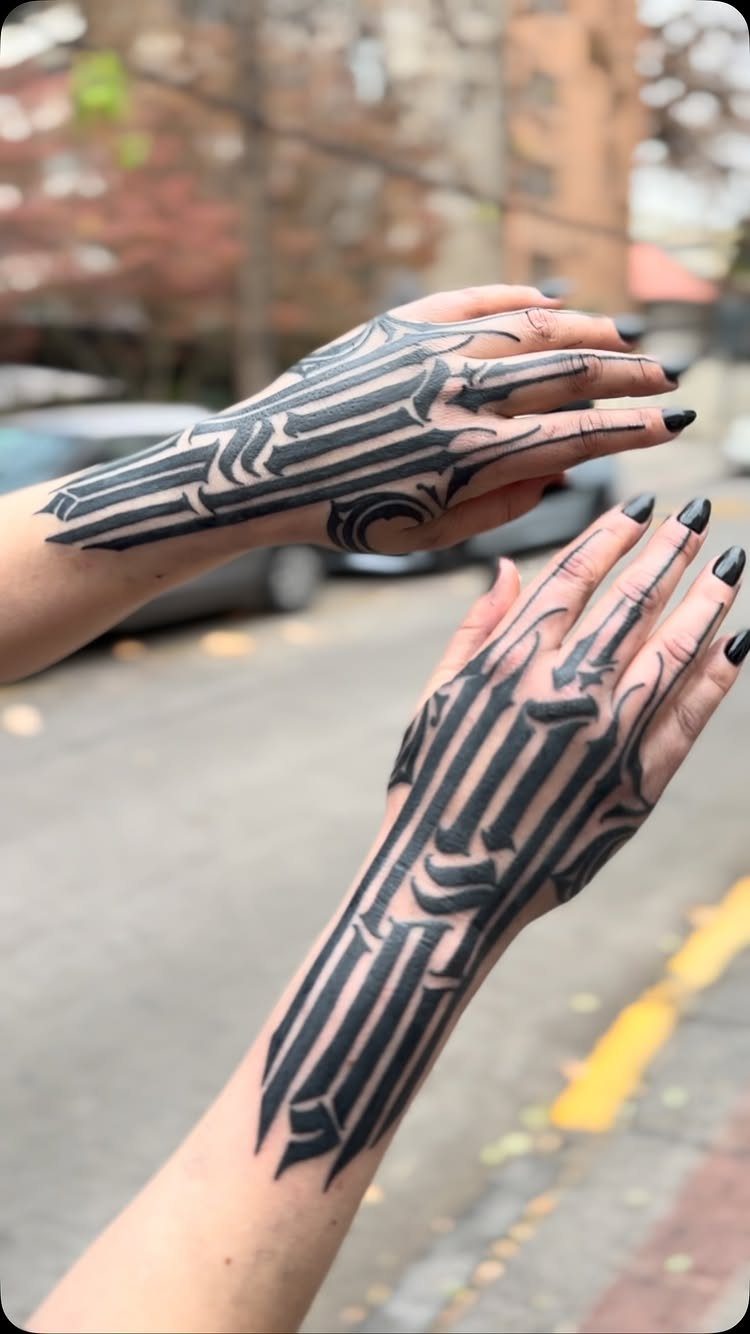
Black bars following the metacarpals turn anatomy into architecture. The geometric lines run from wrist base to knuckle, matching bone with ink so exactly that the hand seems flayed and rebuilt.
This geometry turns the hand into something mechanical, almost armored; the effect works best in plain daylight, not against busy backgrounds.
This is blackwork at its most structural. The lines must align with actual bone, which means the artist palpates as much as draws, finding each ridge and planning around it.
Deviation makes the tattoo look taped on rather than grown from within. The same linework on male hands loses the decorative contrast and reads harder, more structural.
The commitment is total. These bars do not soften or fade into something gentler; they are what they are, and removal would require covering the whole hand in black.
Guys who choose this have already decided that structure matters more than flexibility, that being read as controlled is worth the rigidity the tattoo implies.
Pain Levels of Hand Tattoos
The back of the hand sits in the middle of the pain range, not mild but not the worst spot on the body.
Bone lies close under thin skin, and the nerves there are numerous, yet the flat surface lets the artist work without the constant movement that fingers demand.
Fingers rank higher. Skin sits thin over bone here, and the knuckles pack enough nerve endings that most guys feel it immediately.
Sessions run shorter for a reason: 1 to 2 hours maximum is what most artists recommend before the swelling and fatigue turn precision into guesswork.
The palm is its own category. The skin is thick but the nerve density is extreme, and the constant pressure of gripping objects during healing makes the aftermath as rough as the session itself.
Few artists will do a full palm piece in one sitting, and some will not do them at all.
Numbing cream is out there, and some swear by it. It does not eliminate sensation entirely, and the effect fades partway through longer sessions, which is why artists who allow it still plan around the clock.
Maintenance and Fading
Hand tattoos fade faster than work on the chest, back, or thigh, and the reasons are built into daily life. You wash your hands dozens of times daily, each rinse pulling a little more ink toward the surface.
Sun hits them whenever you drive, walk outside, or sit near a window. The skin on the hands turns over faster than almost anywhere else on the body, and fresh cells do not carry the pigment the old ones held.
Thick outlines survive where fine lines blur.
A design with weight to its borders stays readable years longer than hairline work that looked crisp on day one. Black holds up better than color; greywash softens to a haze that the original artist might not recognize.
Plan for maintenance. Most hand work needs a touch-up after 2 to 3 years, sooner if your job puts you outdoors or in water.
The touch-up is usually shorter and cheaper than the original, but it is part of the cost you commit to when you choose the placement.
An artist who guarantees hand work without qualification is either inexperienced or optimistic; most will tell you upfront that the hand is a partnership between their machine and your willingness to return.
Healing runs 3 weeks to a month for larger pieces, less for small simple work.
During that window, the challenges are practical: keeping the area clean while you use your hands for everything, avoiding the sweat that pools in palms and between fingers, and resisting the urge to pick at peeling skin you see every moment of the day.
Loose fabric helps, moisturizer helps, but there is no shortcut around the fact that hands are tools you cannot rest.
Professional Considerations
Some industries accept visible hand tattoos without comment. Others treat them as a hard barrier.
The difference is not always predictable from the outside: a construction crew may not care while a restaurant kitchen with customer visibility does, and corporate offices vary by city, by company culture, and by whether the role faces clients directly.
Small and minimal designs draw less attention than full coverage.
A small triangle or slim band looks intentional from across a table, and a watch or ring can hide it when you need to. That partial coverage is not deception; it is reading the room you chose to enter.
Large-scale hand work announces itself before you speak. In fields where first impressions are currency, that announcement can cost opportunities before you are aware they existed.
If your current employer tolerates visible ink, consider whether your next one might not, and whether your skills are strong enough to override the visual signal.
Some guys time hand tattoos to career milestones: after reaching a senior role where competence is established, after shifting to self-employment, or after accepting that certain paths are not theirs to walk.
The choice is valid either way, but it should be a choice, not a surprise you discover at the interview.
Frequently Asked Questions
What are some creative tattoo ideas for men?
Skulls, snakes, dragons, mandalas, and gothic knuckle lettering all sit well on masculine hands, each one reading clearly from across a room.
Blackwork animal duos and geometric sacred elements like the evil eye or pentagram also hold up well against daily wear. The male hand punishes fine detail over time, so thick outlines and bold contrast age better than delicate linework.
Are hand tattoos recommended?
That depends on whether you can live with constant visibility. No long sleeve hides a hand tattoo for a job interview or formal occasion, so the commitment is as much professional as personal.
The skin here also faces sun and friction daily, which means faster fading and almost guaranteed touch-ups down the line.
What is the hand symbol tattoo?
This usually refers to sacred or protective imagery placed on the hand, such as the evil eye, pentagram, or mandala.
Geometric and sacred motifs carry weight because the hand is always on display; the choice of what to put there becomes part of how you move through a room.
Do hand tattoos hurt for men?
Yes, more than fleshier spots. Bone sits close to skin across the whole hand, and on the top side needles drum straight against tendons and nerve bundles.
Pain runs highest at the knuckles and fingers, where bone sits closest to surface and flexing never stops. Most artists limit sessions to 1 to 2 hours for comfort and swelling control.