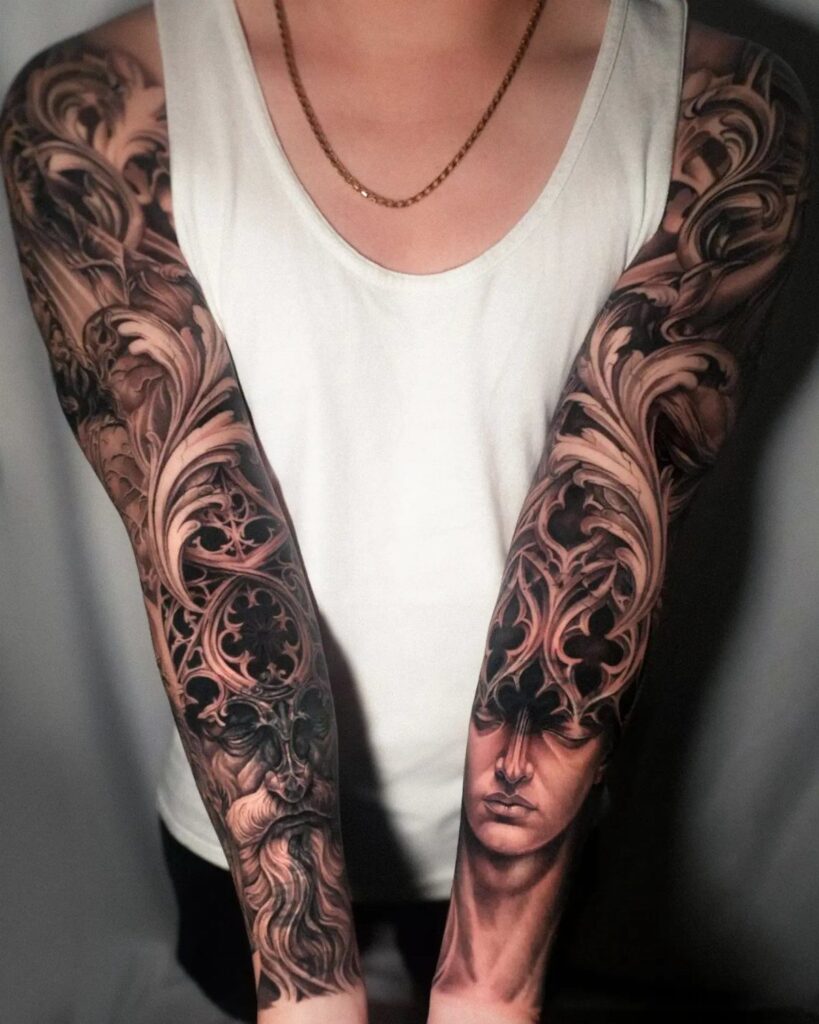
A filigree sleeve can stay pure ornament or let a central image break the pattern, and the designs below run both ways.
Scrollwork alone ages cleaner when backed by solid black patches, while roses or a lion give the eye somewhere to land first.
[link-whisper-related-posts]1. Swirling Acanthus Leaf Patterns
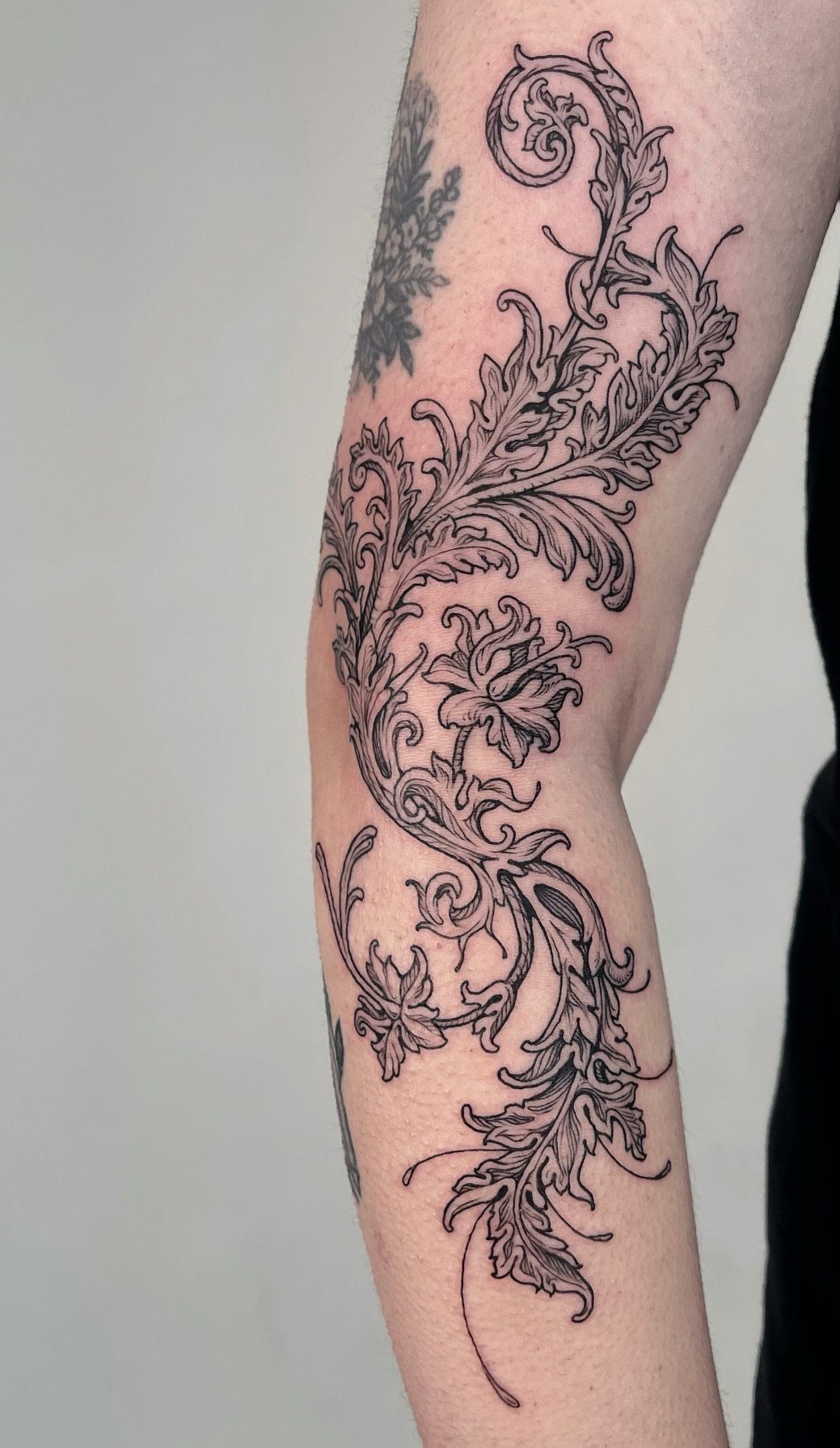
Acanthus leaves carry centuries of architectural history into skin, their curling edges and deep lobes built for wrapping around cylindrical shapes like arms and legs.
Victorian engravers solved this problem before tattoo machines existed: high contrast keeps the pattern readable at distance, while the fine interior lines reward close inspection.
For a full sleeve, I would ask the artist to let the leaves grow denser toward the wrist and open up at the shoulder, following how real muscle moves under skin.
This style demands an artist comfortable with ornamental work; a realism specialist without scroll practice will struggle with the rhythm.

Warm Tips: The tattoo transfer paper need to work with transfer medias.You will need to purchase the stencil ointment separately. Apply the design made on the master paper. Please pay attention to press the back side of the pattern to the skin for at least 3 seconds

24PCS Unique Henna Stencil Pack – This complete henna tattoo kit accessory set includes 24 sheets of reusable mehndi stencils (6.89" x 3.34"). Featuring exclusive designs like long arm bands, moon motifs, vine flowers, and large floral templates, it is ideal for creating DIY temporary skin art on wrists, arms, back, and full body.

✔[FULL SLEEVE TRIBAL TATTOO] Briyhose Tribal Full Arm Temporary Sleeve Tattoos Can Cover Your Body Parts Large. It Contains 4 Sheets 18.9 * 6.7 Inch (48 * 17cm) Long Sleeves Totem Tribal Fake Tattoo Stickers For Adults Men Women Tatto Kit. You Can Share It With Your Family And Friends.
2. Ornamental Scrollwork
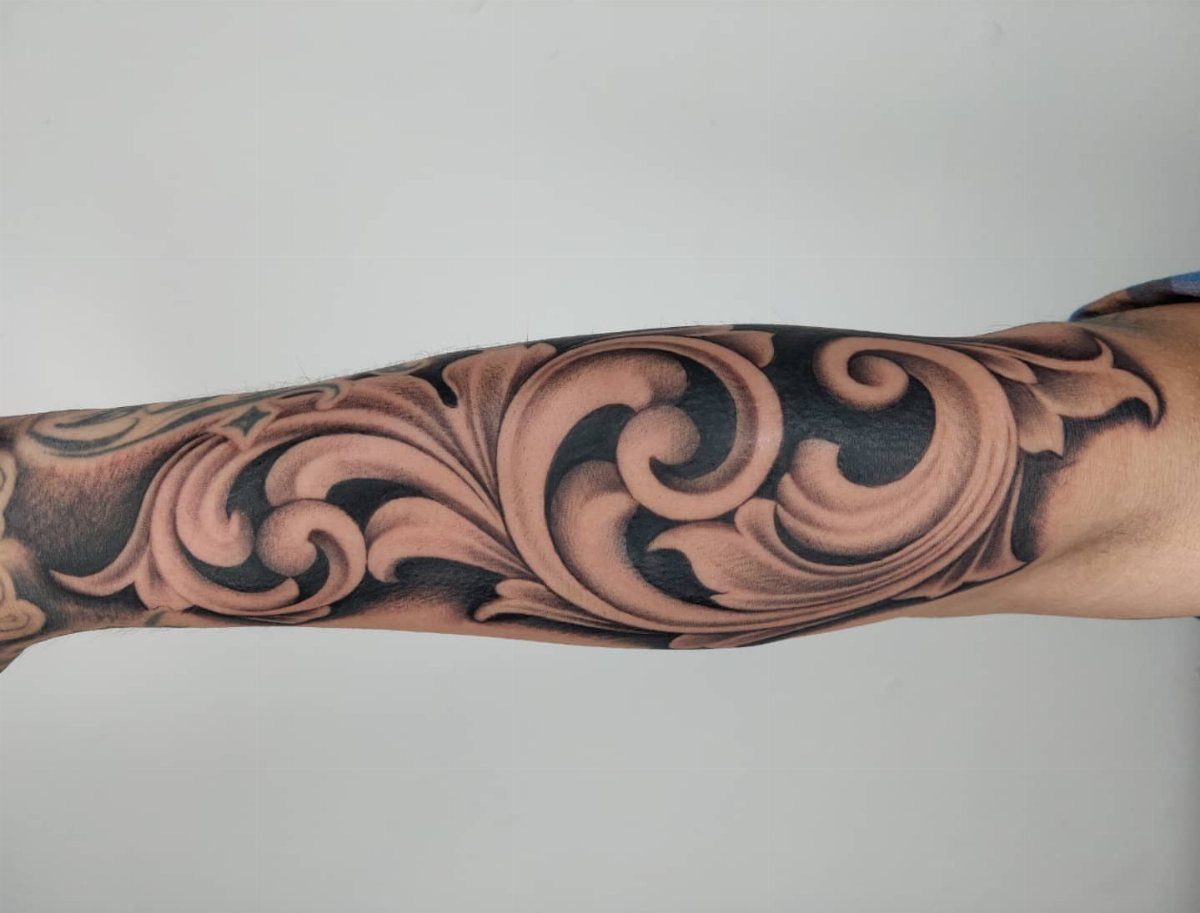
Ornamental scrollwork lives or dies by its negative space, the skin left bare between black ink curves.
Solid background patches serve a practical purpose: they age better than thin lines alone, giving the eye somewhere to rest as the pattern wraps.
Fine line detail requires a steady hand and a single session where possible; going back into healed scrollwork to tighten edges rarely matches the original crispness.
Scrollwork can extend past the sleeve boundary onto the hand itself, though that commitment limits future career options more than arm-only work.
NOTE : All sizes refer to the actual size of the pattern on the stencil ( Including built-in registration marks ) , the size of the stencil will be a little bigger because of the edge . Some designs have two options (style A and B) ,If you choose style A , you will get full design. If you choose style B , you will get one half or two halves of the design .

NOTE : All sizes refer to the actual size of the pattern on the stencil ( Including built-in registration marks ) , the size of the stencil will be a little bigger because of the edge . Some designs have two options (style A and B) ,If you choose style A , you will get full design. If you choose style B , you will get one half or two halves of the design .
3. Realistic Roses Intertwined with Ornamental Filigree Patterns
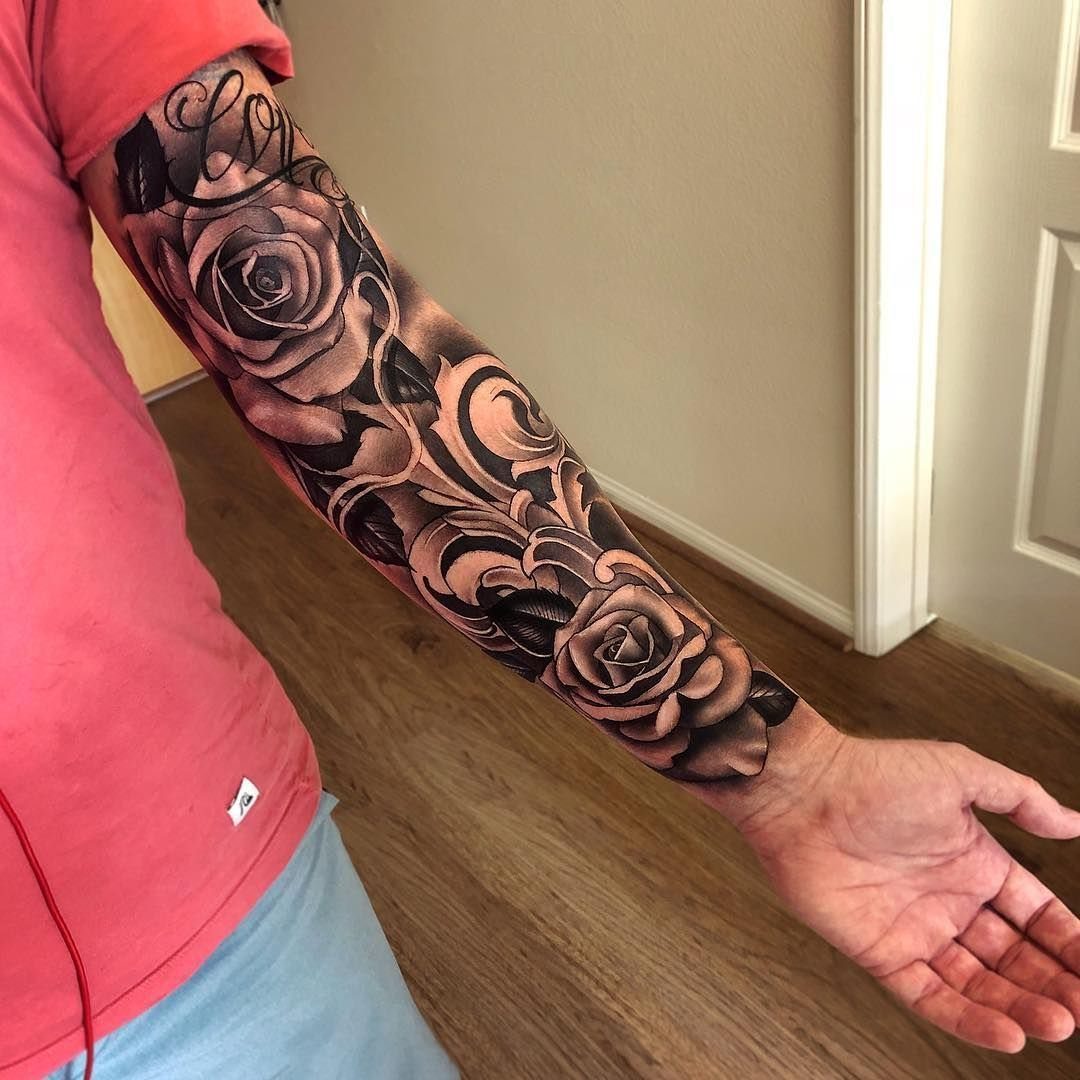
Pairing realistic roses with filigree solves a problem pure ornament cannot: giving the eye a focal point that reads immediately, with the scrollwork providing secondary reward.
Forearm placement keeps the roses at natural viewing distance for conversation, while the filigree extends toward the elbow where detail matters less. A skull variation trades romance for memento mori weight, though the same structural rules apply.

100% brand new and high quality

Triple Blackout Tattoo Ink - Strengthen your shading with Triple Blackout, the boldest black designed for greater dimension in your tattoos. With a glycerin free formulation, this professional tattoo ink inserts smoothly into the skin for excellent distribution and shading.
Premium Tattoo Black Ink – Allegory BLAK is a smooth, consistent blend of liquid dispersed pigment. Many of the most popular tattoo artists around the globe uses Allegory BLAK Ink for precise lining and shading. Allegory BLAK is the stepping-stone to the future of tattooing.
4. Black Ink Swirling Vine Patterns
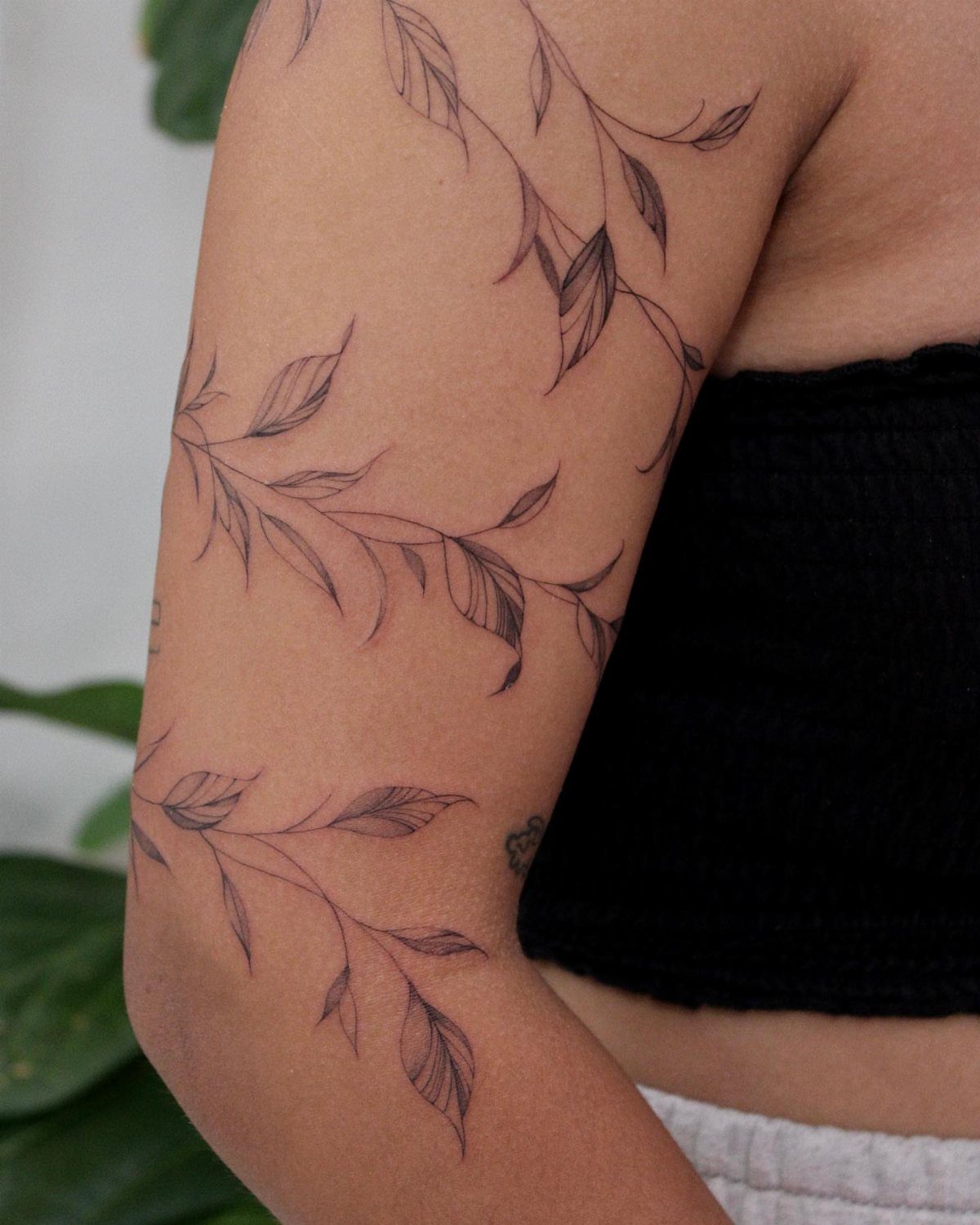
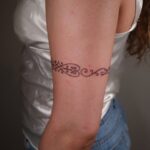
Vine patterns offer filigree’s elegance without its historical heaviness, the leaf motifs lighter and more botanical than architectural. Fine-line execution suits arms that already carry busier pieces elsewhere, or a first sleeve where the wearer wants ornament without intimidation.
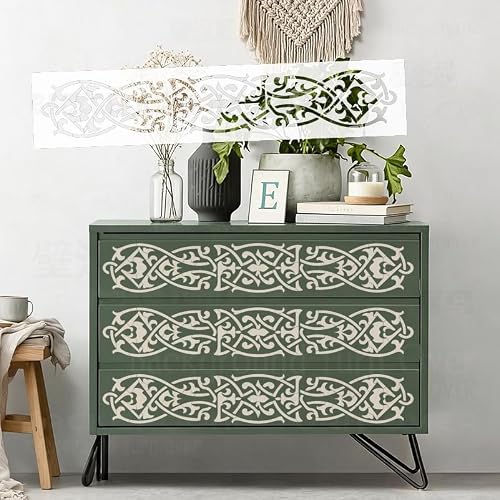
Mirrored symmetrical compositions, as one source shows, work for chest or back placements; on an arm, I would push for the continuous vertical flow visible in the stencil design, letting the vine climb with the muscle rather than fighting it.
Black ink alone keeps the delicacy; adding grey wash would thicken the apparent line weight over years.

Acanthus Leaf Pattern Stencil: 8Pcs various patterns can meet your different needs, well made and fun to create craft projects for families and friends, offers endless possibilities for transforming your home decor

Leaves Pattern Stencil: You will receive a plant-themed painting template with the size of 11.8x11.8 inch/30x30cm; This template takes leaves as the main element, integrates rotating and dynamic design, making each leaf as delicate and beautiful as dancing with the wind.

Variety Botanical Pattern: This set of hand face painting stencils contains 12 sheets 142+pcs Wildflower Floral tattoo Stencils for daily use, such as wildflower, floral, narrow leaves, plants, Spring flowers, butterfly etc allow children and adult to give full play to their imagination and fill in patterns freely
5. Religious Portrait with Filigree Sleeve
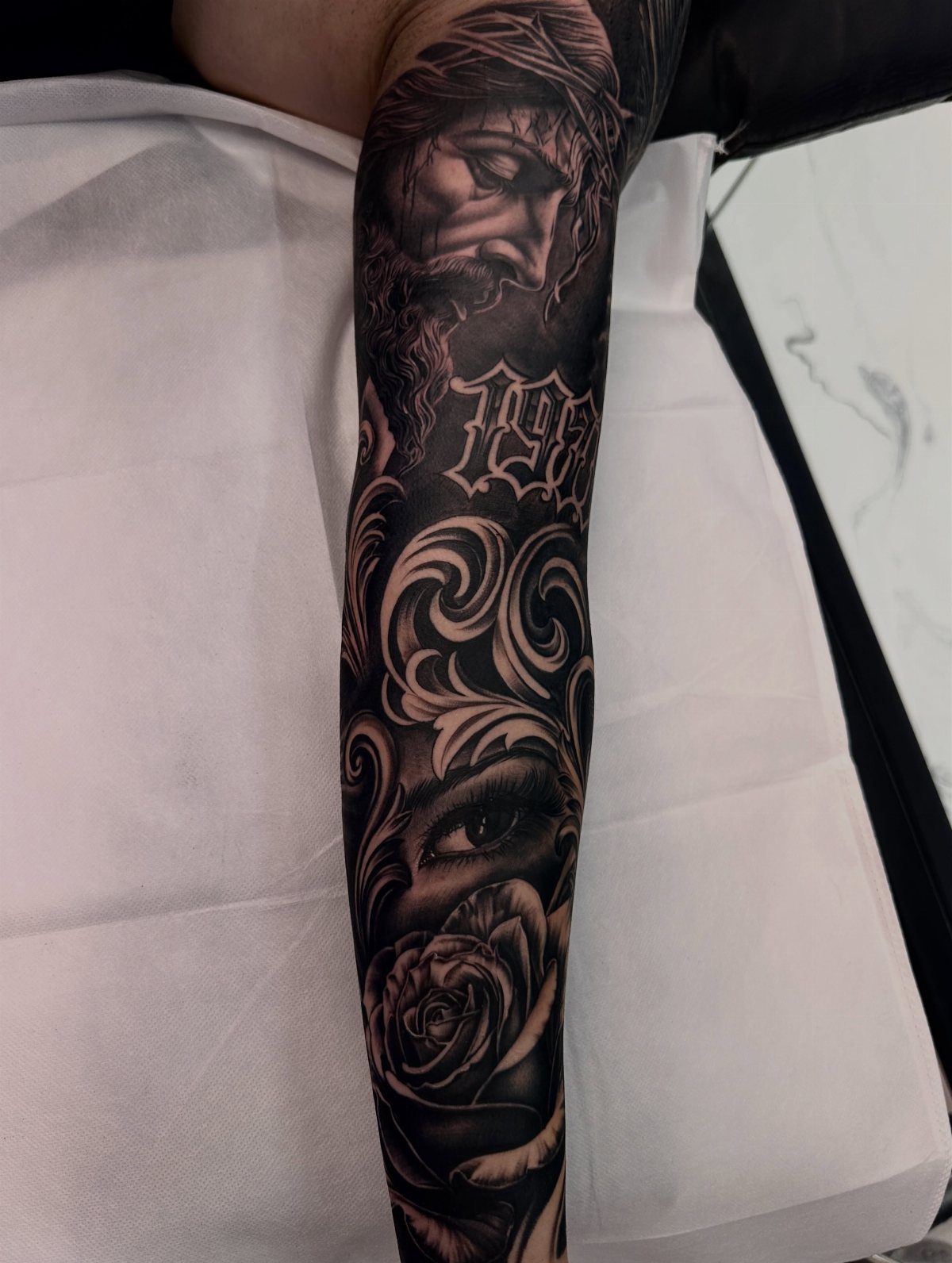
Religious portraiture surrounded by filigree draws from a specific tradition: Catholic iconography where the sacred figure floats in ornamental glory, separated from the worldly by pattern.
A portrait anchors the sleeve with narrative weight, while Gothic numbers, an eye, or a rose give the artist smaller moments of detail between the filigree’s flow.
This density of symbolic elements risks visual noise; I would limit myself to two or three motifs beyond the central portrait, letting the scrollwork carry the rest. Chest placement, as one variation shows, allows larger scale for the figure itself.

Rose Temporary Tattoos : You'll receive 8 sheets rose flower temporary tattoos, each measuring 12x17cm (4.7x6.7 inches). No designs repeat, so you can switch them up and share them anytime
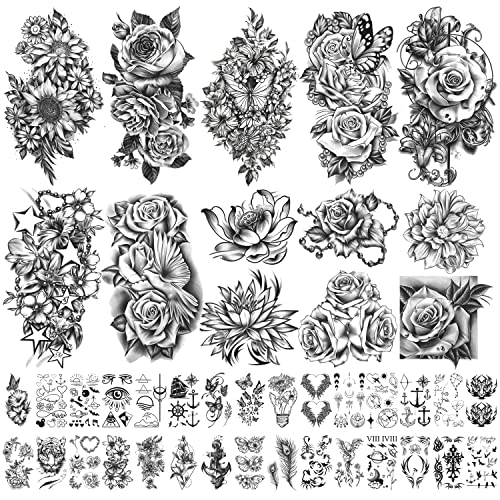
[LARGE SIZE & LARGE QUANTITY] Large size flowers collection tattoo stickers can cover your body parts larger, size is 9.45 * 5.35 inch (24 * 13.6cm) 10 sheets, 3.9 * 2.3 inch (9.8 * 5.8cm) 30 sheets .You can share it with your family and friends

★【26 Sheets Large Butterfly Rose Temporary Tattoos For Women】--COKTAK Brand Multicolor Mixed Style Vintage Rose Flower Temporary Tattoos For Adults. 【Size】Package Includes 12 Sheets 7.8"X3.7" Inches/19.8x9.6cm Large Temporary Tattoos For Thigh Leg And 14 Sheets 3.86"X2.28 Inches/9.8x5.8cm Small Temporary Tattoos For Fingers Hands.
6. Lion Motifs with Filigree Patterns
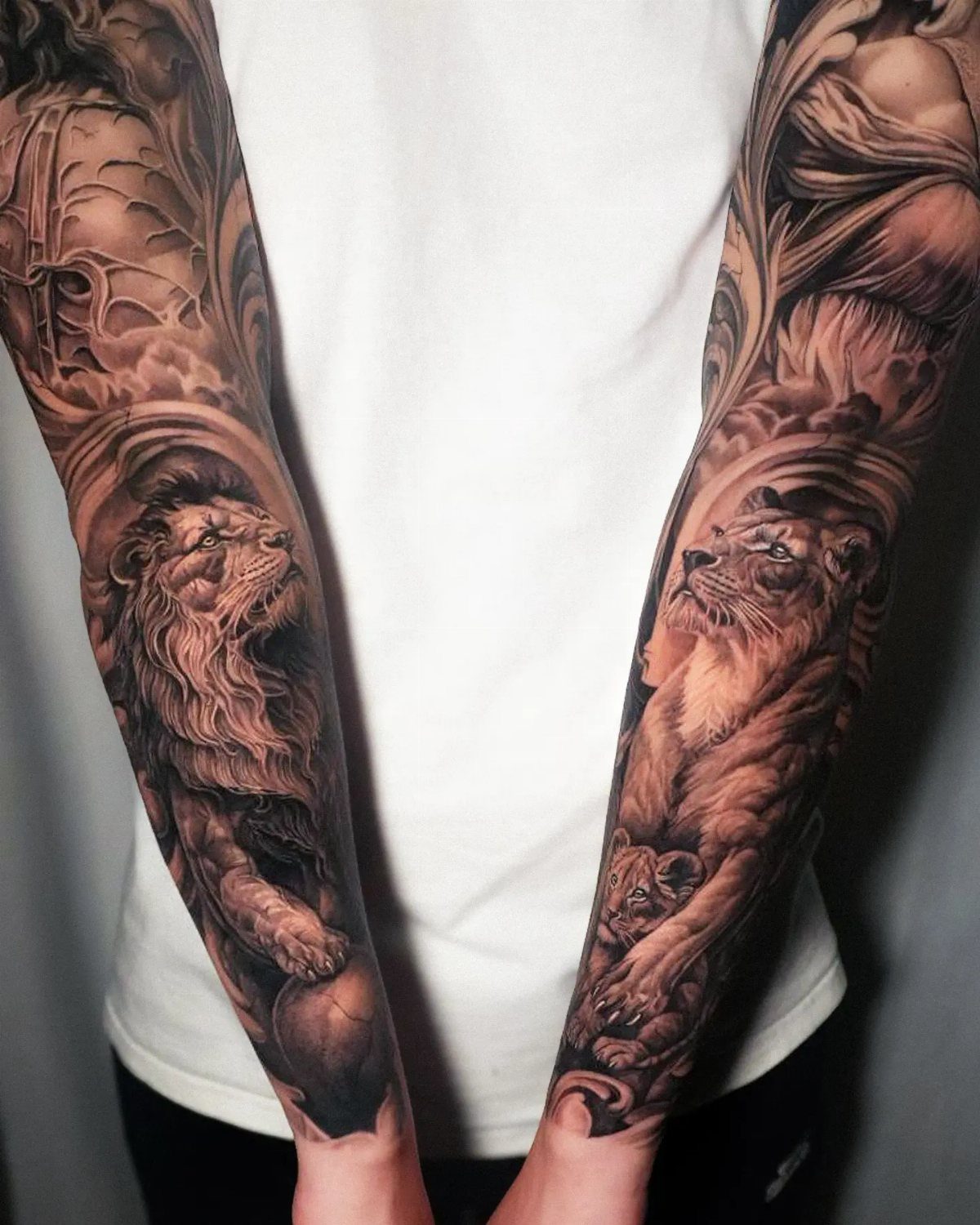
Lion imagery with filigree borrows from heraldic tradition: the animal as emblem, surrounded by decorative proof of its importance. Matching sleeves take a baroque approach, the lions almost sculptural against scrolling blackwork, with a cub softening the aggression.
Symmetrical paired sleeves demand planning; starting one without mapping both risks mismatched weight or flow. The ornamental filigree here reads heavier than vine or leaf alternatives, suiting larger builds where fine detail would disappear.
For a single arm, I would place the lion’s face at the shoulder, letting the mane dissolve into scrollwork toward the wrist.

【 575+ Fun Assorted Tattoo Stencils 】-The ChurlChurl tattoo stencils collection includes 575 high quality stencils with multiple themes. enjoy cute trendy tattoo stencil designs like butterflies, words, flowers, symbols, totem, Egypt style patterns and more.

【 Temporary Tattoo Sleeves 】 : Include 8 sheets full sleeve temporary tattoos (size: 19 x 7 inches) .

⯁ 400+ Reusable Henna Stencils: Get 24 sheets of high-quality, self-adhesive hollow templates featuring over 400 unique patterns. These temporary tattoo stencils allow you to create stunning body art including mandalas, butterflies, and dragons. Perfect for practicing techniques without permanence
Creative Ideas for Filigree Tattoos
Filigree tattoos work well beyond the sleeve. Chest filler behind a Victorian cross, back pieces, and hand work all use the same scroll vocabulary at different scales.
A hand placement compresses the pattern to its essentials; the knuckles and fingers leave no room for the gradual shading that saves a sleeve from flatness.
Skulls paired with filigree shift the tone from decorative to memento mori without changing the line technique.
The skull provides the weight, the scrollwork the frame. For women drawn to softer imagery, dainty floral filigree keeps the intricacy while dropping the Gothic heaviness.
Men often push toward stronger ornamental or blackwork versions, though the line between those categories blurs in practice. What reads as masculine or feminine depends more on scale and contrast than on the motif itself.


9Pcs Scrollwork Pattern Stencils: 9 different styles can meet your different needs, well made and fun to create craft projects for families and friends, offers endless possibilities for transforming your home decor
Symbolism of Filigree Tattoos
Translated to skin, that same density of labor signals commitment. A sleeve of fine scrollwork took hours the wearer chose to spend on something permanent.
The specific motifs carry their own weight. Heraldic lions wrapped in scrollwork claim lineage, real or invented.
The risk is pretension.
Filigree can announce sophistication so loudly it drowns personal meaning. I would test any design against a simple question: does the pattern serve the image, or has the image become an excuse for the pattern?

Smooth: A homogenized carrier/pigment mixture that flows easily
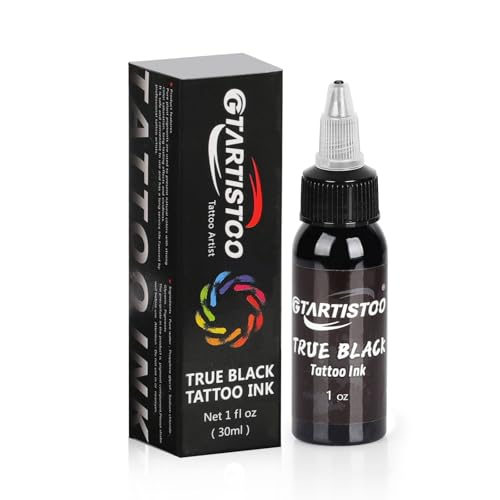
🖤Professional-Grade Tattoo Ink: This tattoo ink is designed for professional tattoo artists and studio use, suitable for bold outlines, shading, and solid black work in daily tattoo applications.

100% new brand and high quality. Favored among professional tattoo technicians.
Placement Considerations
A full sleeve from shoulder to forearm gives filigree the vertical run it needs. The pattern climbs with the arm’s natural line, denser toward the wrist where the cylinder narrows and the eye expects detail to gather.
Symmetry demands advance planning. Matching sleeves, or a sleeve paired with chest work, require the artist to map negative space across multiple sessions before any ink goes in.
Starting one side without the other risks mismatched weight; the scrollwork on the left will not naturally mirror the right unless both were drawn as a set.
A single-arm filigree sleeve leaves the other arm open for future work, though some wearers later regret the imbalance it creates.
The geometry changes: flat planes versus curved, radiating patterns versus vertical flow.

Package Including: Pack of 10 Sheets temporary tattoo stencils. All the designs are shown in the pictures. Only has tattoo template, no tattoo ink

The packaging includes; You will receive 12 different Leaf Vine Stencils, with a wide range of styles and sufficient quantities. The Reusable Leaf Stencil for Craft can meet your daily use and replacement needs

20 PCS Flower Leaves Border Stencils: You will receive 20PCS creative hollow out plant theme template. The template sets features various of flower vine leaves patterns. A variety of patterns and plenty of quantity can meet your various needs, and you can also share them with your family and friends!